La Aljafería: a taifa palace that is a parliament today
The only great surviving witness to eleventh-century Islamic art in Europe, with arches that anticipate the Alhambra by two hundred years. What to look at, what was added later and why you should book.
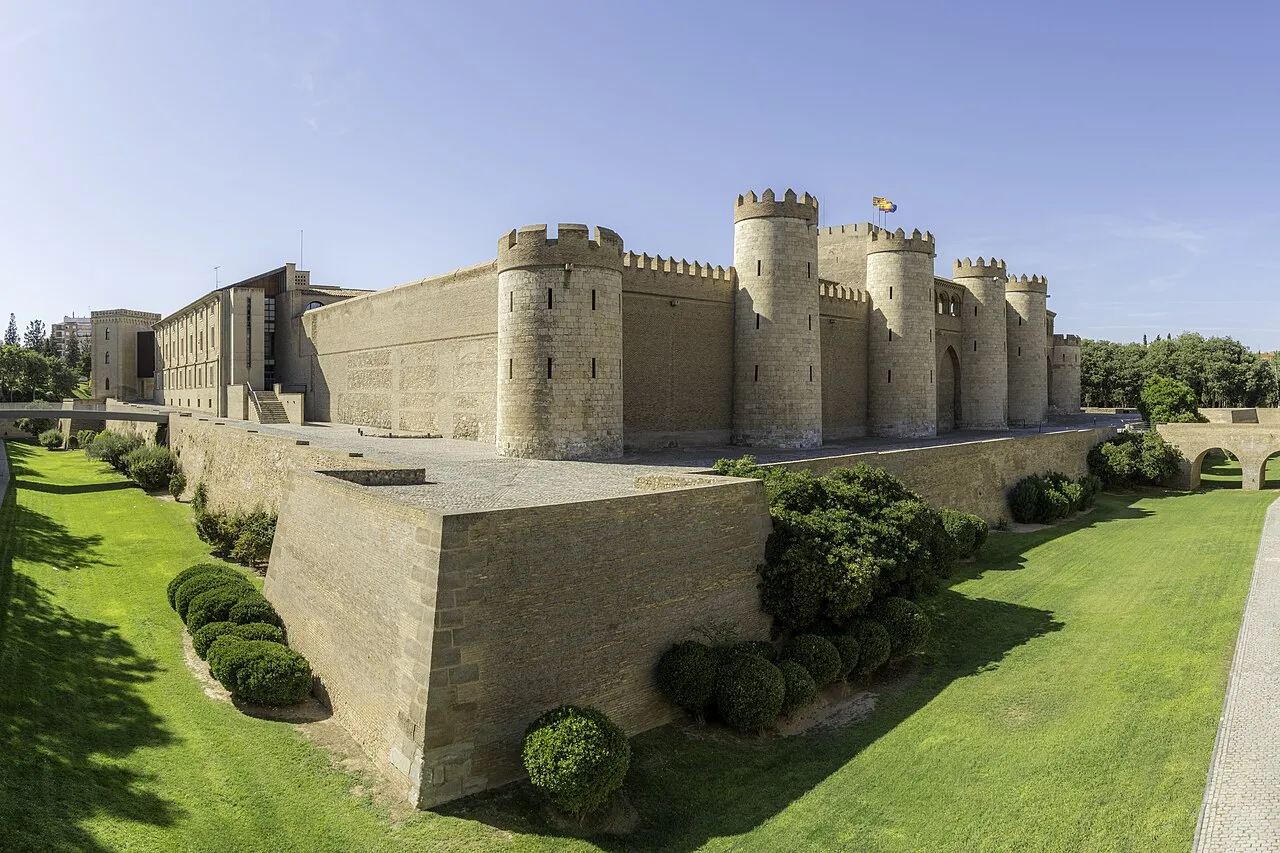
Al-Andalus left very little palace architecture this far north, and of the little there was almost nothing survived. That is why this building is exceptional: a pleasure palace built in the eleventh century, when Zaragoza was an independent kingdom, which came down to us almost whole and which today houses the Cortes de Aragón. A thousand years of continuous institutional use in the same building.
It is the seat of the regional parliament, so visiting hours change with the activity of the Cortes: there are days with limited access and days when it is closed. Check before you travel and book in high season.
Taifa art, and why it matters
Eleventh century, between Córdoba and Granada.
When the caliphate of Córdoba broke apart at the beginning of the eleventh century, the Andalusi peninsula fragmented into taifa kingdoms, and the one in Zaragoza was among the most prosperous and cultivated. This palace went up then as a pleasure residence outside the walls, at a moment of enormous intellectual and artistic refinement.
That period is the missing piece in most tours of Spanish Islamic art, which tend to go from the Mezquita of Córdoba to the Alhambra skipping two centuries. Here is what came in between, and it explains how you got from one to the other.
What you have to look at are the arches: interlaced, lobed, mixtilinear, layered over several planes until they form lattices that no longer have any structural function. It is the step beyond what had been done in Córdoba, taken to an almost abstract extreme where the arch stops holding anything up and becomes pure drawing.
The Salón Dorado, the Golden Hall, and the courtyard with its pool are the central pieces, with plasterwork, capitals and arcades that directly anticipate what would be done in Granada two centuries later. Seeing this before the Alhambra changes how you read that place entirely.
Entry around 5 €, and a good hour for the visit. It is twenty minutes on foot from the centre or a few minutes by tram: it is the only sight in Zaragoza that requires going outside the old town, and it is worth it beyond argument.
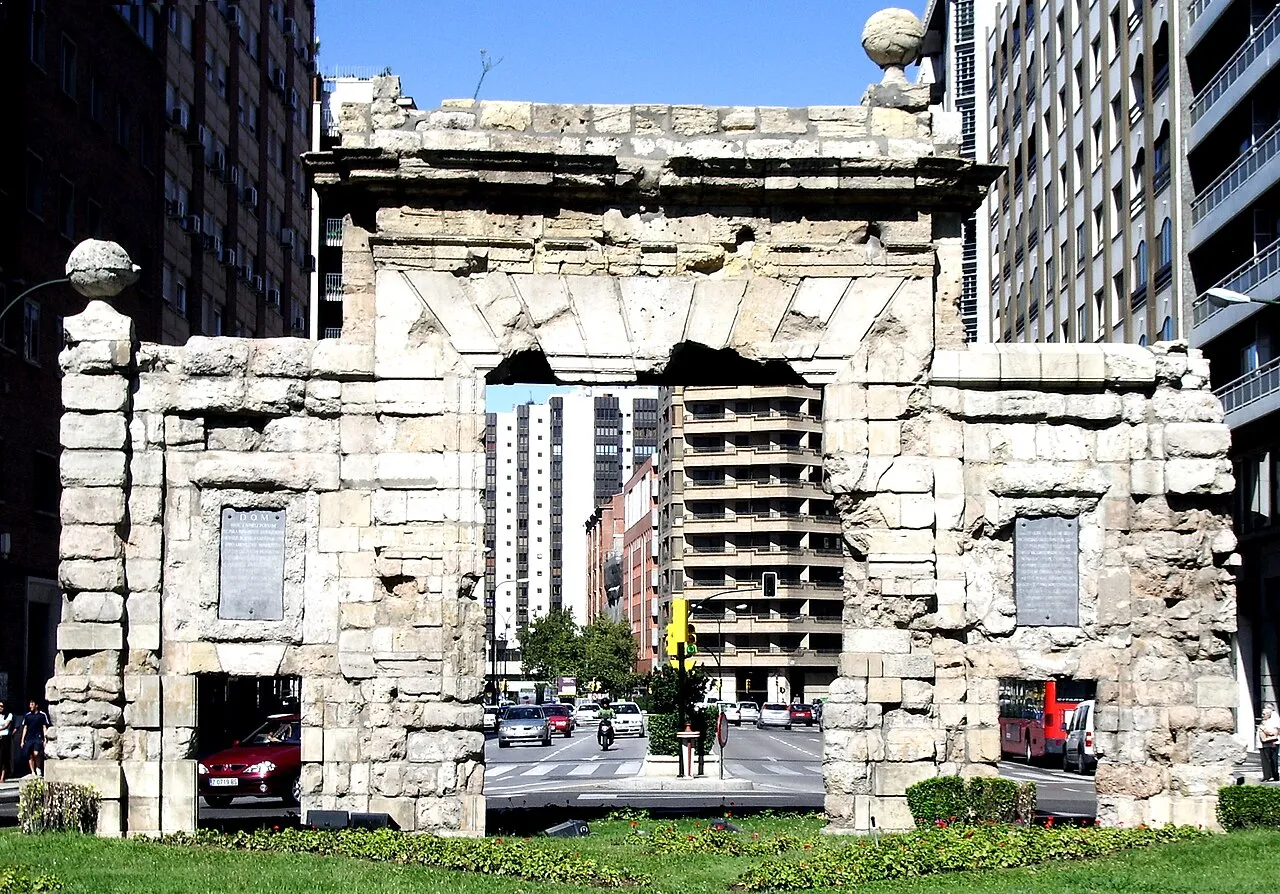
On the way between the centre and the Aljafería, the last gate of the city's enclosure, its ashlar riddled with impacts from 1809 that were deliberately left unrepaired. It is the only place where you can physically touch what happened in the Sieges.
Download the app and discover Zaragoza offline, whenever you like. Take the walking tour La Aljafería and palatial Zaragoza with a local guide in your ear.
After the Christian conquest of 1118, the building was not destroyed: it became the palace of the kings of Aragon, who used it for centuries. That continuity is what allowed the Andalusi decoration to survive, when elsewhere it disappeared completely.
In the fifteenth century, the Catholic Monarchs added a whole floor on top with state rooms and a polychrome Mudéjar coffered ceiling of exceptional quality, with their coats of arms and with the yoke and the arrows repeated. The result is a building where the eleventh and the fifteenth centuries live vertically, one on top of the other.
Then came the fall. It was the seat of the Inquisition, then a military barracks, and it ended up half ruined, with the Andalusi decoration chipped away, walled up or dismantled. Photographs from the beginning of the twentieth century show an unrecognisable building.
The restoration that brought it back is long, painstaking and from the second half of the twentieth century, and at some points it has been argued over for the extent of the reconstruction. It is worth knowing: not everything you see is original, although the general approach was conservative.
A parliament inside a palace
The current use is what closes the story. Since the eighties, the building has been the seat of the Cortes de Aragón, with the plenary chambers and the parliamentary offices built inside the complex, in a contemporary body that lives alongside the historic one.
That decision was deliberate and it has a logic: giving the building back a function of real power instead of turning it into a museum. A thousand years after a taifa king governed from here, it is still the place where decisions about this territory are taken.
The practical consequence is that the visit depends on political activity. On plenary days access is restricted, and the hours vary with the parliamentary calendar, so checking beforehand is not a precaution but a necessity.
It is also worth knowing that the Torre del Trovador, the oldest part of the complex and earlier even than the palace, gave its name to Verdi's opera “Il trovatore”, by way of the Spanish play it was based on. It is a fact people repeat a lot, and it is true.
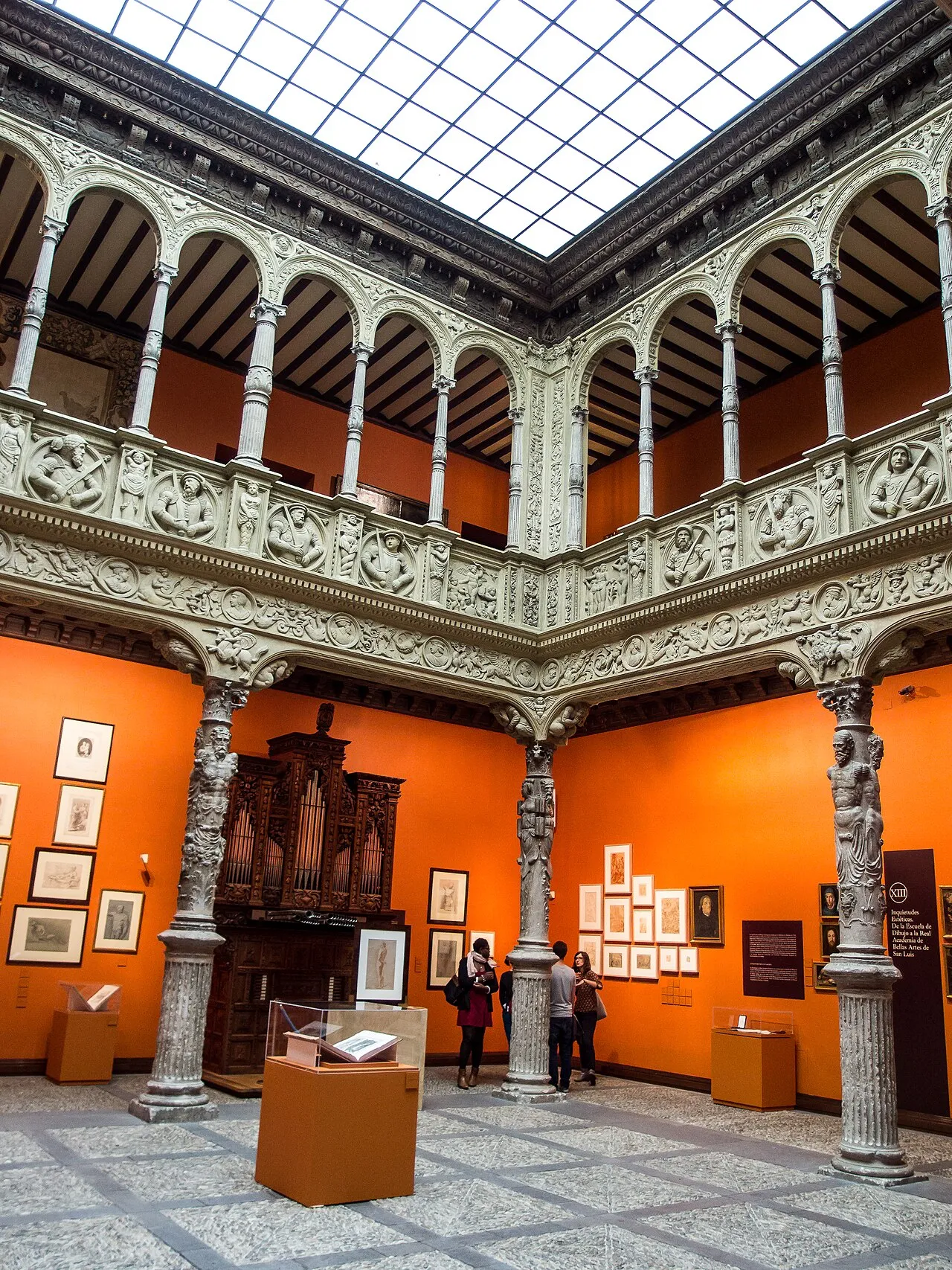
Back in the centre, the other great courtyard of the city: a sixteenth-century Renaissance one that a French antique dealer bought in 1903, dismantled piece by piece and took to Paris, where it stayed for more than fifty years. It came back and was reassembled inside a building on the Coso. Free entry.
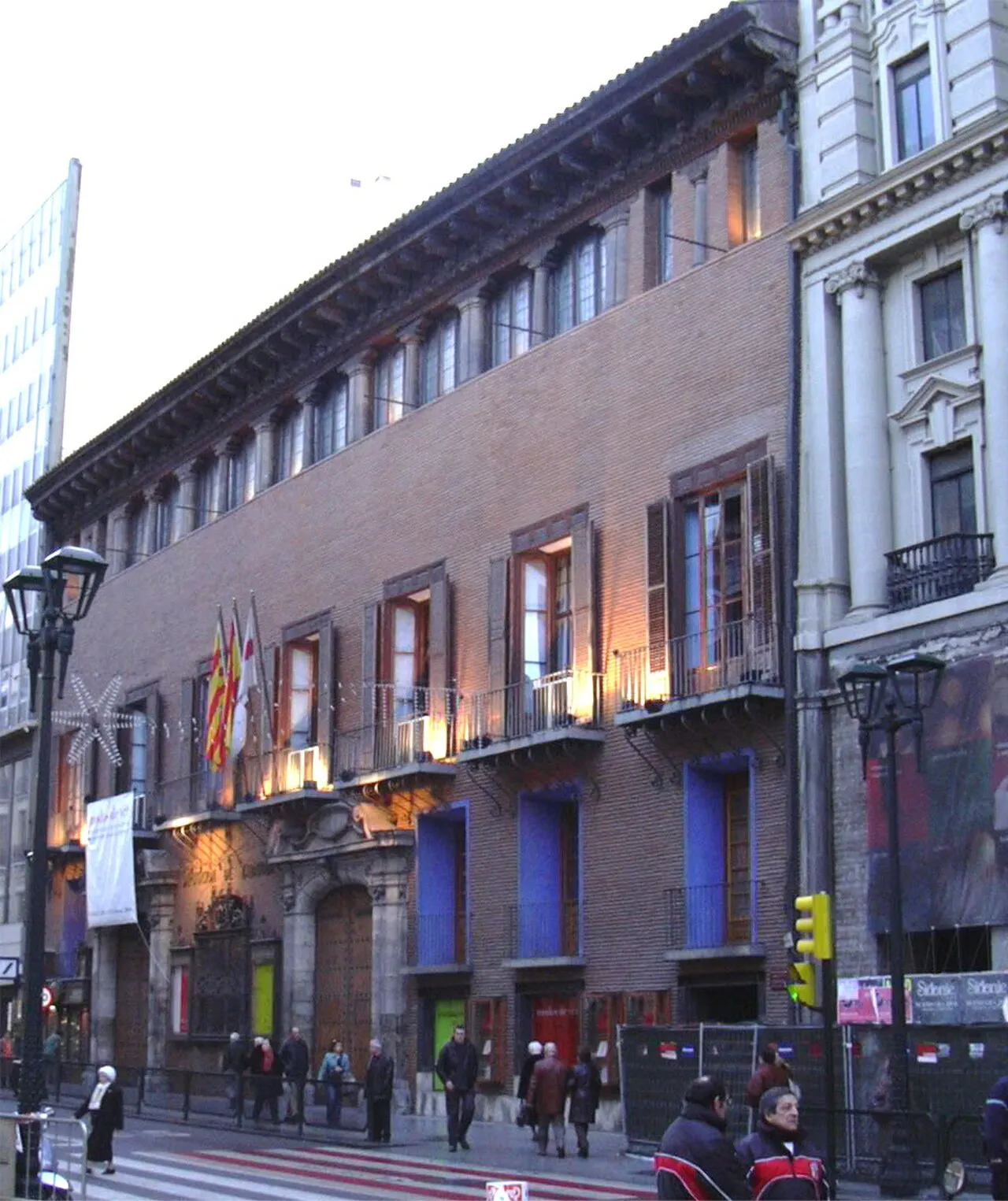
A sixteenth-century Renaissance palace with a two-storey courtyard and the great carved wooden eaves typical of Aragonese civil architecture. Today it is the provincial council's exhibition space with free entry: you go in, cross the courtyard and come out.
The art produced in the independent kingdoms that emerged when the caliphate of Córdoba broke apart at the beginning of the eleventh century. It is the missing piece in most tours of Spanish Islamic art, which go from the Mezquita of Córdoba to the Alhambra skipping two centuries. La Aljafería is what came in between.
Why is it compared with the Alhambra?
Because its interlaced and lobed arches, layered over several planes until they form lattices with no structural function, directly anticipate the language that would be developed in Granada two centuries later. Seeing it first changes how you read the Alhambra, because it explains where what you admire there comes from.
Do you have to book?
It is strongly advisable, above all in high season. The building is the seat of the Cortes de Aragón and visiting hours change with parliamentary activity: on plenary days access is restricted and there are days when it is closed. Checking before you travel out there is not a precaution but a necessity.
What did the Catholic Monarchs add?
A whole floor on top of the Islamic palace, in the fifteenth century, with state rooms and a polychrome Mudéjar coffered ceiling of exceptional quality, with coats of arms and with the yoke and the arrows repeated. The result is a building where the eleventh and the fifteenth centuries live vertically, one on top of the other, with neither wiping out the other.
How much of it is original?
The building went through the Inquisition and a long spell as a military barracks and ended up half ruined, with the Andalusi decoration chipped away or walled up. The restoration in the second half of the twentieth century was long and painstaking, but at some points it has been argued over for the extent of the reconstruction. Not everything you see is original.
Is the Verdi opera story true?
Yes. The Torre del Trovador, the oldest part of the complex and earlier than the palace itself, gave its name to Verdi's “Il trovatore” by way of “El trovador”, the Spanish play by Antonio García Gutiérrez on which the opera is based. The tower can be visited as part of the route.
Practical information
WhereCalle de los Diputados, to the west. 20 minutes on foot from the centre or a few minutes by tram.
TicketsAround 5 €. Booking advisable in high season.
Opening hoursConditioned by the activity of the Cortes: some days have limited access. Check beforehand.
DurationA good hour.
TipIf you are going to Granada, do this first: seeing the taifa arches changes how you read the Alhambra.
On the wayThe Puerta del Carmen, with the impacts of 1809 left unrepaired.
On the map
🎧 With Viavoy
Walk Zaragoza and listen at your own pace
Download Viavoy and walk Zaragoza offline, whenever you like.
from 2,99 €· one-off payment
City Pass · 9,99 €3 days, all the tours in Zaragoza