1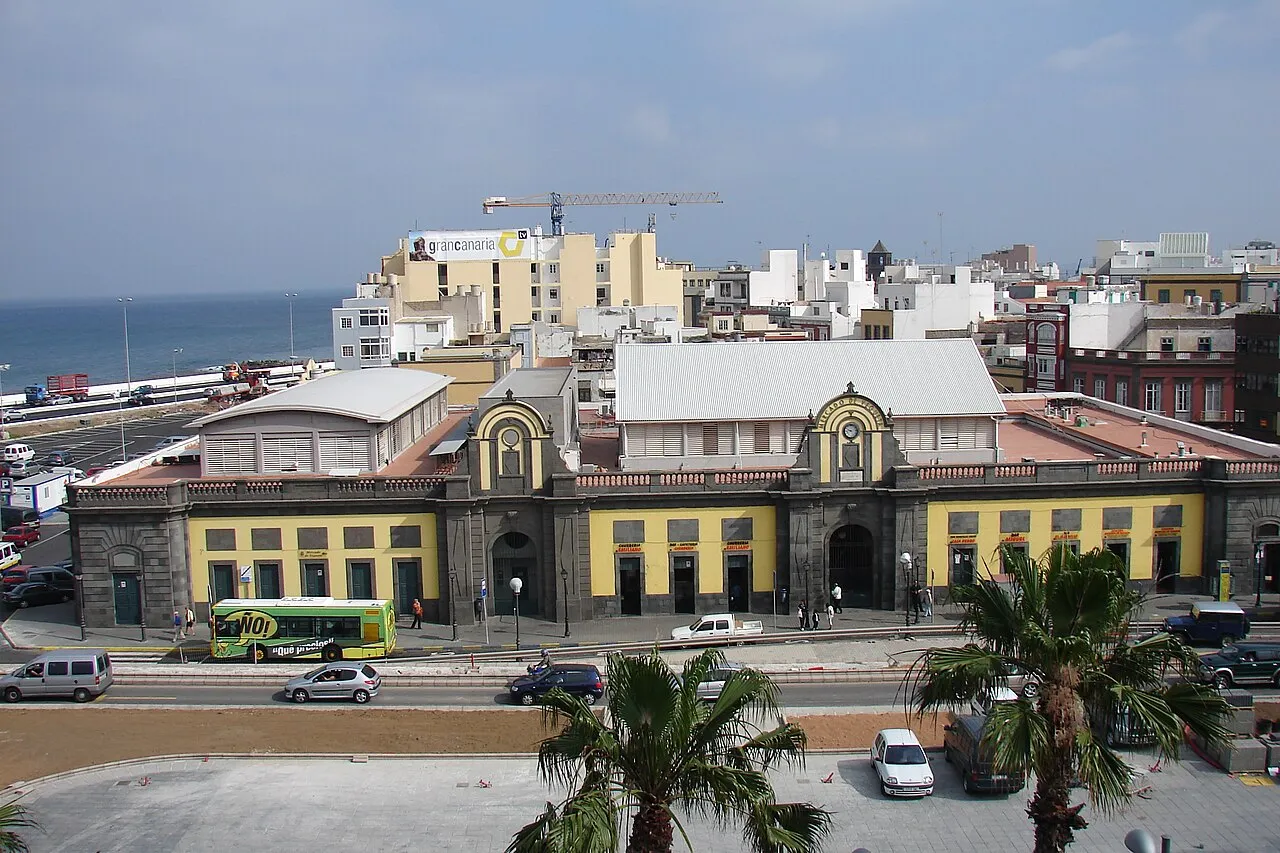
Vegueta Market
📍 Beside the Guiniguada ravine
The oldest market in the Canary Islands, from around 1856, with a central courtyard ringed by galleries. There are stalls where you can eat tapas-style with what you buy next door.
Potato varieties brought from America in the sixteenth century, toasted flour older than the conquest and goat cheeses that barely leave the archipelago.
🎧 On the walk Vegueta: the Cathedral, Columbus and the founding quarterCanarian cooking does not resemble any other Spanish cooking, and the reason is geographical: for centuries these islands were closer to America than to the mainland, and they were a compulsory stop for everything that crossed the Atlantic. The result is a larder with ingredients that are everyday nowhere else in the country.
Papas arrugadas, wrinkled potatoes, are the emblematic dish: small potatoes boiled unpeeled with a lot of salt, until the water evaporates and the skin is left wrinkled and covered in a fine crust of salt. They are eaten whole, with the skin on, and dipped.
The interesting part is the varieties. The old Canarian papas descend from tubers brought from America in the sixteenth century, and many have practically disappeared in their place of origin: here they are still grown on small plots, with names such as papa negra, bonita or borralla.
The mojos are the two sauces that come with almost everything. The red one, or picón, has dried pepper, garlic, cumin, oil and vinegar, and goes with meat and with the papas. The green one, with coriander or parsley, goes with fish. They are served separately, in a bowl, and the rule is that you dip, you do not pour it over the top.
In fish, the vieja is the queen: a fine-fleshed rock fish that here is eaten boiled with papas and mojo, and that outside the archipelago you practically cannot find. Also cherne, sama and bocinegro.
The oldest market in the Canary Islands, from around 1856, with a central courtyard ringed by galleries. There are stalls where you can eat tapas-style with what you buy next door.
Download the app and discover Las Palmas offline, whenever you like. Take the walking tour Vegueta: the Cathedral, Columbus and the founding quarter with a local guide in your ear.
Find out more about Viavoy →Gofio is toasted grain flour — wheat or millo, the Canarian maize — finely milled, and it is the oldest food in the Canary Islands. The ancient Canarians, before anyone arrived from Europe, ate a similar toasted grain that they called “ahoren”. We have been eating it for millennia.
It is used in a thousand ways: kneaded with broth, sprinkled over a stew, whisked with milk or banana, in desserts. At first it is disconcerting and then it turns out to be fairly addictive. Ordering it is the quickest way to eat something genuinely pre-Hispanic.
The cheeses are the other great chapter. Canarian cheeses are mostly goat's cheese, with their own denominations on several islands, and they are eaten fresh, semi-cured or smoked. Very little of it leaves the archipelago.
In stews, rancho canario and puchero, with chickpeas, meat and vegetables. And for dessert, bienmesabe, with almond and honey, and frangollo, once again based on millo. All of that can be found in the Vegueta Market and on any local menu.
To drink, Canarian wines, which are living through an excellent moment: they are grown on volcanic soil and the varieties — listán negro, malvasía, marmajuelo — are not found anywhere else.
The Vegueta Market is the first stop, and in the morning: it is where you see the whole larder and where you can sit down to eat tapas-style with what has just been bought at the stall next door. After midday it loses its charm.
In Vegueta and Triana there is a good density of Canarian restaurants, in the streets parallel to the Calle Mayor and around the Plaza de Santa Ana. It is the area with the best balance of quality and atmosphere.
In the northern zone, the Mercado del Puerto — iron and glass, next to the La Luz Castle — has become a very lively food hub, with tapas stalls and a good deal of atmosphere at night.
And in Las Canteras, the promenade is full of restaurants with terraces looking out to sea. Prices go up on the front row, but dining while watching the sun set over the Atlantic is worth it at least once.
A useful note: in the Canary Islands restaurant prices tend to be somewhat lower than on the mainland, among other reasons because IGIC, the local indirect tax, is lower than mainland VAT.
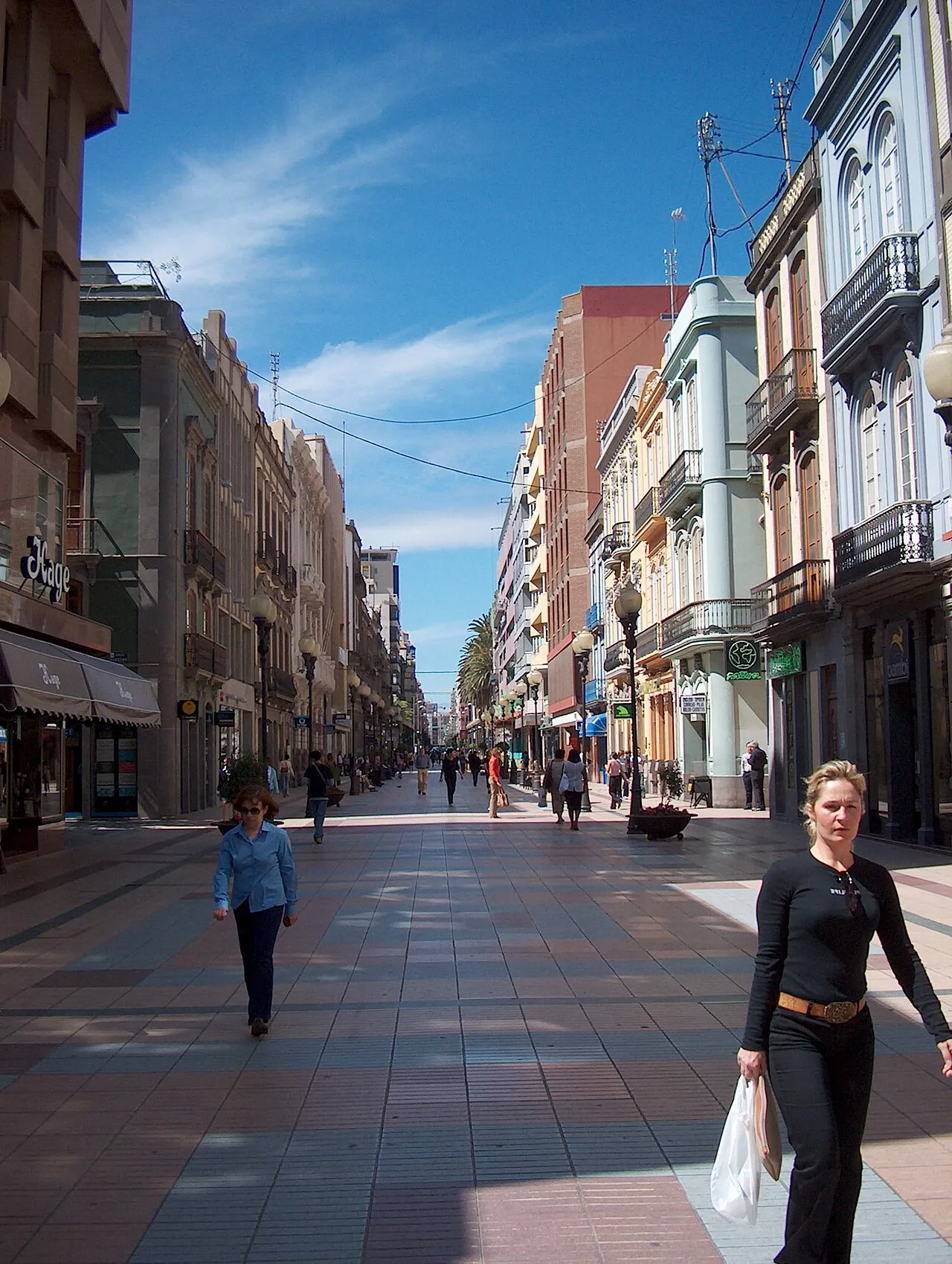
Its parallel streets hold the best density of Canarian cooking in the centre, at reasonable prices and with Art Nouveau façades thrown in.
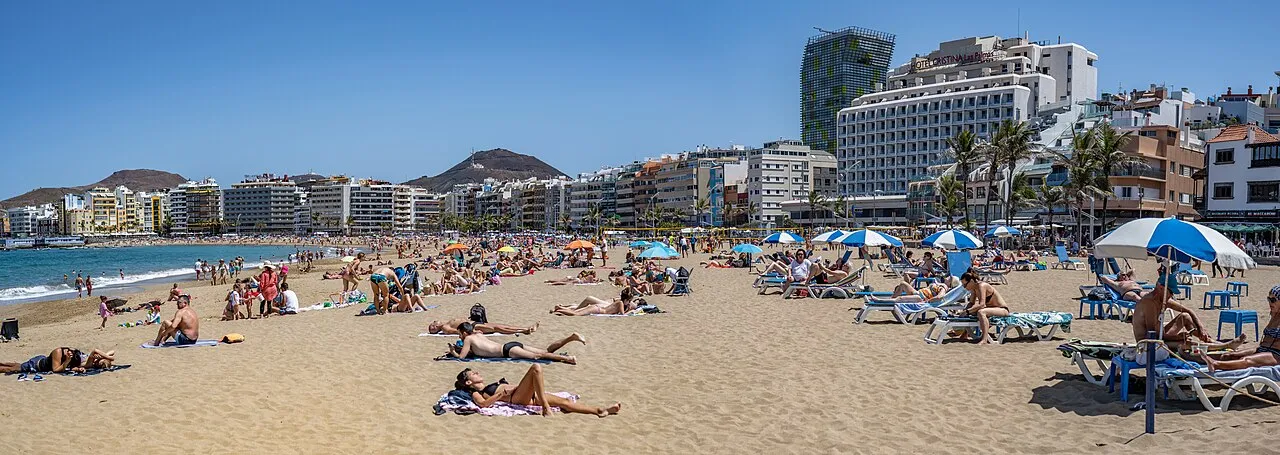
The promenade is full of terraces looking out at the Atlantic. Prices go up on the front row, but dining at sunset is worth it once.
Small potatoes boiled unpeeled with a lot of salt, until the water evaporates and the skin is left wrinkled and covered in a fine crust of salt. They are eaten whole, with the skin on, dipped in mojo. Many of the varieties used descend from tubers brought from America in the sixteenth century that have almost disappeared in their place of origin.
Red mojo, or picón, has dried pepper, garlic, cumin, oil and vinegar, and accompanies meat and the papas. Green mojo has coriander or parsley and goes with fish. They are served separately, in a bowl, and the local rule is simple: you dip, you do not pour it over the plate.
Toasted grain flour — wheat or millo — finely milled, and the oldest food in the Canary Islands. Before the conquest the ancient Canarians were already eating a similar toasted grain that they called “ahoren”. It is taken kneaded with broth, sprinkled over a stew, whisked with milk or banana and in desserts.
The vieja, which is the queen of the Canarian table: a fine-fleshed rock fish that here is eaten boiled with papas and mojo and that outside the archipelago you practically cannot find. Also cherne, sama and bocinegro, all of them fresh that day if you eat near the coast.
The Mercado de Vegueta in the morning, to understand the larder and eat tapas-style. To sit down, the streets parallel to the Calle Mayor de Triana and the area around the Plaza de Santa Ana have good Canarian cooking at reasonable prices. And the Mercado del Puerto, in the northern zone, has become a very lively food hub.
Very much so, and it is living through an excellent moment. It is grown on volcanic soil and the varieties — listán negro, malvasía, marmajuelo — are not found anywhere else in the world. It is one of the things most worth trying here, because outside the archipelago distribution is still scarce.
It tends to be somewhat cheaper than on the mainland, among other reasons because IGIC, the local indirect tax, is lower than mainland VAT. In Las Palmas, moreover, most restaurants work for people from the city and not for passing tourism, except on the beachfront.
Download Viavoy and walk Las Palmas offline, whenever you like.

Keep reading