Eating in Girona: mar i muntanya, suquet and xuixos
Food and drink · Girona

Eating in Girona: mar i muntanya, suquet and xuixos

The cooking of the Empordà combines on the same plate what the sea and the mountains yield half an hour apart. What to order, which wine and why this province has so much fine dining.

8 min read · Updated for 2026
🎧 On the walk Monumental Girona: the cathedral, the Jewish Call and the Onyar houses

The province of Girona is small and has everything within half an hour: sea on the Costa Brava, mountains in the Pyrenees and the Garrotxa, and agricultural plain in the Empordà. That proximity explains the most characteristic dish of its cooking, mar i muntanya, which brings together meat and shellfish without any shyness, and it also explains why here there is a density of top-level restaurants hard to match in Europe.

Mar i muntanya is not modern fusion: it is peasant cooking from an area where the fisherman and the stockbreeder lived fifteen kilometres apart. Chicken with lobster or meatballs with cuttlefish are dishes that have always been here.

Mar i muntanya, the dish that defines the area

Meat and shellfish on the same plate.

The best known is chicken with lobster or with langoustines, stewed with a long-cooked sofrito and bound with a picada of almond, hazelnut, garlic and parsley, and often with a touch of dark chocolate. It sounds strange written down and works perfectly at the table.

The logic is not one of fusion but of geography. In the Empordà, the coast and the agricultural interior are fifteen or twenty kilometres apart, and the markets have always combined produce from both areas. The cooking simply used what was in the same square.

Other usual versions are meatballs with cuttlefish, rabbit with snails and prawns, and the stew of pig's trotters with prawns. They all share a structure: a patient sofrito, stock, and a picada at the end to bind and give character.

The picada, in fact, is the central technique of all traditional Catalan cooking: a pounded mixture of nuts, fried bread, garlic, herbs and sometimes chocolate or biscuit that is added at the end to thicken and perfume. Without a picada there is no Catalan stew.

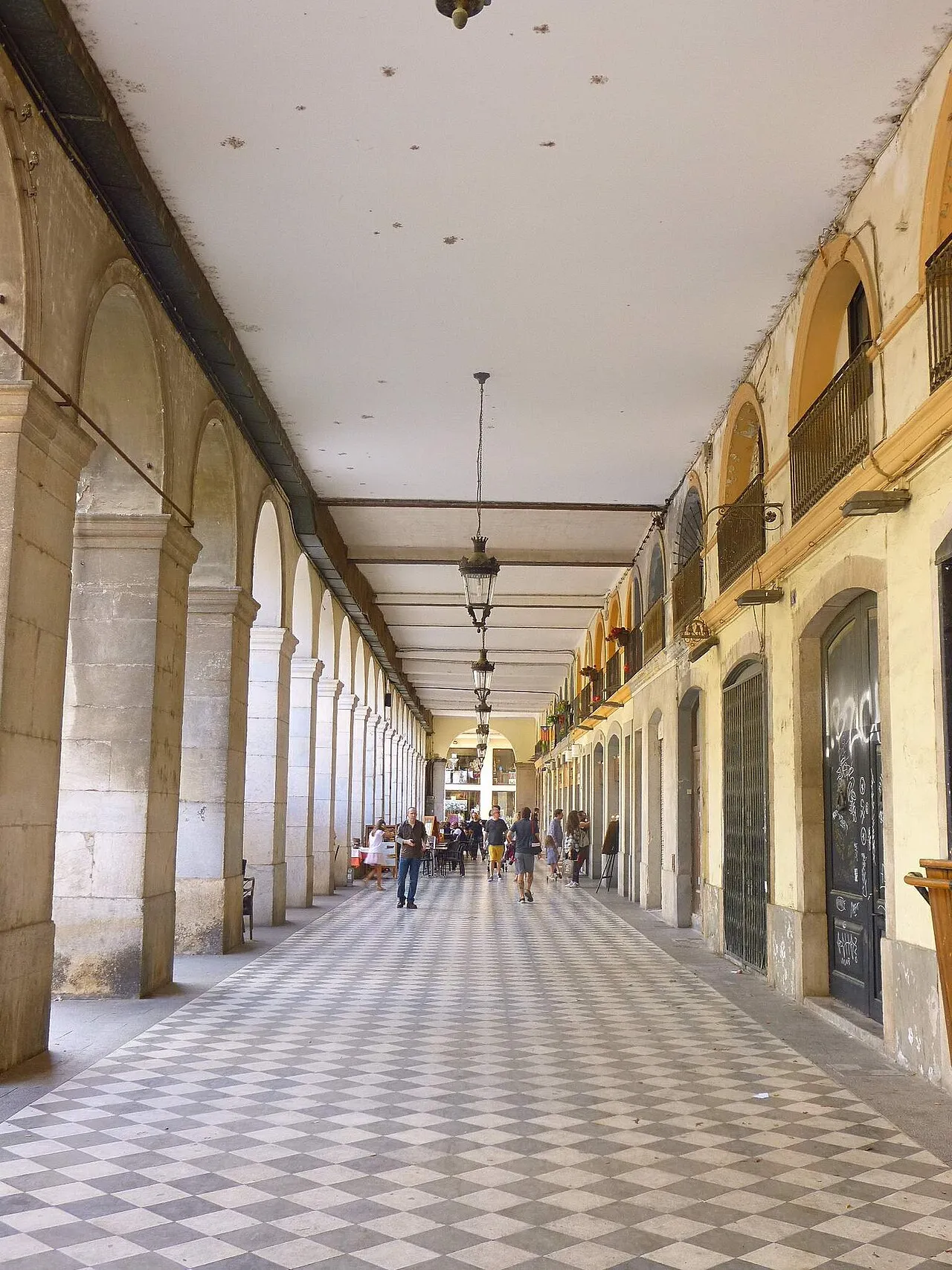
1Rambla de la Libertad

Rambla de la Libertad

📍 Beside the river Oñar

The arcaded artery of the old town, with terraces beneath the porticoes and a good part of the city's cafés and bars. It is the most convenient area for eating, with the advantage of being two minutes from the bridges and the start of the Call.

🎧 With Viavoy

Explore Girona at your own pace

Download the app and discover Girona offline, whenever you like. Take the walking tour Monumental Girona: the cathedral, the Jewish Call and the Onyar houses with a local guide in your ear.

Find out more about Viavoy →

From the sea, the vegetable garden and the oven

From the sea, suquet de peix: a fishermen's stew of rockfish with potato, sofrito and picada, which was born as food on board made with what could not be sold. And the rice dishes, the fideos a la cazuela, noodles cooked in a casserole, and the grilled fish of the villages of the Costa Brava, less than an hour away.

From the vegetable garden, escalivada — pepper, aubergine and onion roasted over the fire, peeled and dressed —, trinxat in the mountain areas, ganxet beans and Empordà artichokes, which have recognised quality. And bread with tomato as the default accompaniment to everything.

The cured meats of the Empordà and the Garrotxa are a category in themselves: fresh butifarra, black and white butifarra, fuet and llonganissa, and the sweet butifarra, a local rarity made with sugar and lemon and eaten as a dessert or with apple.

And for something sweet, the xuixo: a bun of fermented dough, fried, coated in sugar and filled with custard cream, which was invented in Girona and is eaten above all at breakfast or as an afternoon snack. It is the city's sweet and you find it in any bakery in the centre.

2Plaza de la Independencia

Plaza de la Independencia

📍 On the other side of the Oñar

A neoclassical arcaded square with restaurants on all its sides, across the river from the old town. It is the classic area for eating in Girona, with wide terraces and proper tables, and it works well when the old town is saturated.

Frequently asked questions

What is mar i muntanya?

Dishes that combine meat and shellfish in the same casserole, typical of the Empordà: chicken with lobster or langoustines, meatballs with cuttlefish, rabbit with snails and prawns. It is not modern fusion but cooking that has always been here, because in this area the coast and the agricultural interior are fifteen or twenty kilometres apart and the markets mixed both kinds of produce.

What is a picada?

A pounded mixture of nuts — almond, hazelnut —, fried bread, garlic, parsley and sometimes dark chocolate or biscuit, which is added at the end of a stew to thicken it and give it character. It is the central technique of traditional Catalan cooking: without a picada, a Catalan stew is not finished.

What is a xuixo?

A bun of fermented dough, fried, coated in sugar and filled with custard cream. It was invented in Girona and is eaten above all at breakfast or as an afternoon snack. You find it in any bakery in the centre and it is, together with the sweet butifarra, the sweet that gives the city its identity.

What is sweet butifarra?

A local rarity of the Empordà: a pork sausage made with sugar and lemon instead of the usual spices, eaten as a dessert or accompanied by apple. It is a medieval product that has survived only in this district and is quite disconcerting the first time.

Why is there so much fine dining in Girona?

For decades the province has concentrated a density of world-class restaurants that matches neither its size nor its population. That ecosystem has trained generations of cooks and raised the average level of the whole area, including places without pretensions, which is what anyone travelling without a booking notices.

Where is it best to eat in Girona?

On the Rambla de la Libertad and in the streets of the old town for eating with views; in the Plaza de la Independencia, on the other side of the river, for restaurants with wide terraces and proper tables; and around the market and the Plaza del Vino for produce and more local tapas. The fine-dining restaurants require booking months ahead.

The wine, the fine dining and where to eat

The local appellation is Empordà, one of the oldest in Catalonia, with reds from Garnacha and Cariñena, fresh whites and a tradition of sweet wines — the Garnatxa de l'Empordà — served with dessert. Prices are reasonable and quality has risen a great deal in two decades.

On fine dining: for decades the province of Girona has concentrated a density of world-class restaurants that matches neither its size nor its population. That ecosystem has trained generations of cooks and raised the average level of the whole area, including places with no pretensions at all.

Those restaurants have waiting lists of months and high prices, so they are not a plan you can improvise. But their effect is felt in any set lunch menu in the old town, and that is the good news for anyone travelling without a booking.

On areas: the Rambla de la Libertad and the streets of the old town for eating with views; the Plaza de la Independencia, on the other side of the river, for restaurants with proper tables and wide terraces; and the Mercado del León or the area around the Plaza del Vino for produce and local tapas.

Practical information

The dishMar i muntanya: chicken with lobster or with langoustines, with a long-cooked sofrito and a picada of nuts.
From the seaSuquet de peix, rice dishes and fideos a la cazuela. Grilled fish on the Costa Brava.
From the vegetable gardenEscalivada, ganxet beans, Empordà artichokes and bread with tomato with everything.
Cured meatsFresh, black and white butifarra, fuet, llonganissa and the sweet butifarra, eaten as a dessert.
SweetXuixo: a fried bun filled with custard cream, invented in Girona. In any bakery in the centre.
WineDO Empordà, with Garnacha and Cariñena, and sweet Garnacha wines for dessert.
On the map

🎧 With Viavoy

Walk Girona and listen at your own pace

Download Viavoy and walk Girona offline, whenever you like.

from 3,99 €· one-off payment
City Pass · 9,99 €3 days, all the tours in Girona
Find out more about Viavoy →
Viavoy app

Keep reading

More articles

Itineraries

Girona in a day: the Call, the cathedral and the walls

History

The Jewish Call of Girona: six hundred years and an expulsion

What's on

Temps de Flors: the week Girona opens its courtyards

Themed routes

Girona and Game of Thrones: where Braavos was filmed