1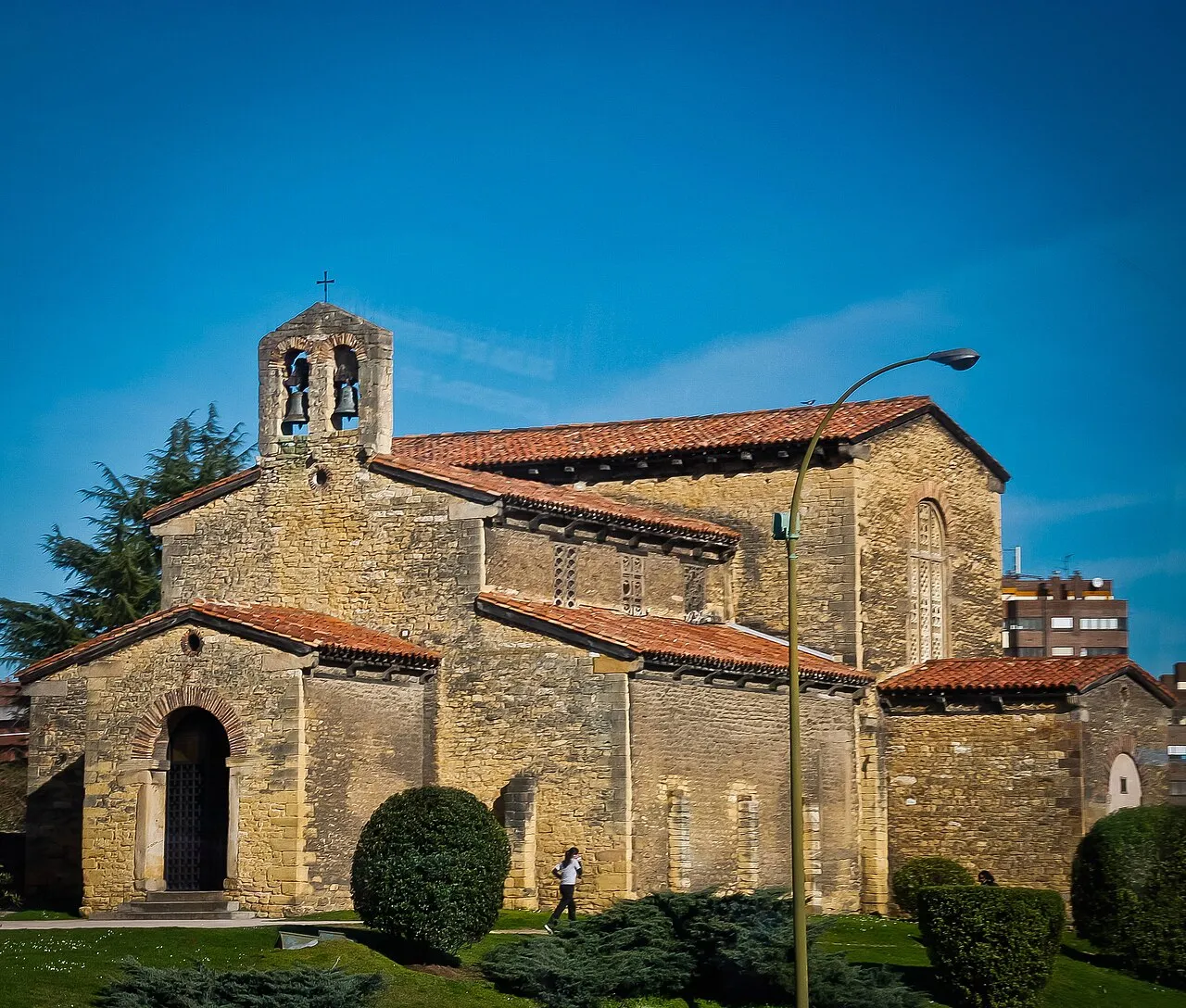
San Julián de los Prados
📍 On the edge of the old town
The largest church of the Asturian Pre-Romanesque, from the beginning of the ninth century, with the most important group of Pre-Romanesque wall painting in Europe.
A ninth-century court art that resembles nothing else, in the capital of a kingdom that held out when half the peninsula was al-Andalus.
🎧 On the walk The University, Santullano and old VetustaIn the eighth century, with half the peninsula under Muslim rule, a king called Alfonso II chose a hill and built a capital. From that kingdom of Asturias an art of its own remains, without equivalent in Europe, and in Oviedo two pieces survive that exist nowhere else on the continent.
Alfonso II the Chaste reigned for more than fifty years, from 791 to 842, one of the longest reigns of the entire Middle Ages in the peninsula. That span was exactly what allowed him to build a whole capital from scratch.
They called him “the Chaste” because he never married and left no descendants, something extremely rare in a medieval king. He chose this hill and raised a complex of palaces and churches that turned Oviedo into a court.
Little of that complex is still standing: the church of El Salvador gave rise to the cathedral, which is Gothic; San Tirso el Real was rebuilt so many times that only one original window survives.
And something else came out of it: in the ninth century, Alfonso II went in person to pray before the newly discovered tomb of the apostle James. He was the first documented pilgrim in history, and his route is today the Camino Primitivo, the original Way, a World Heritage Site since 2015.
The largest church of the Asturian Pre-Romanesque, from the beginning of the ninth century, with the most important group of Pre-Romanesque wall painting in Europe.
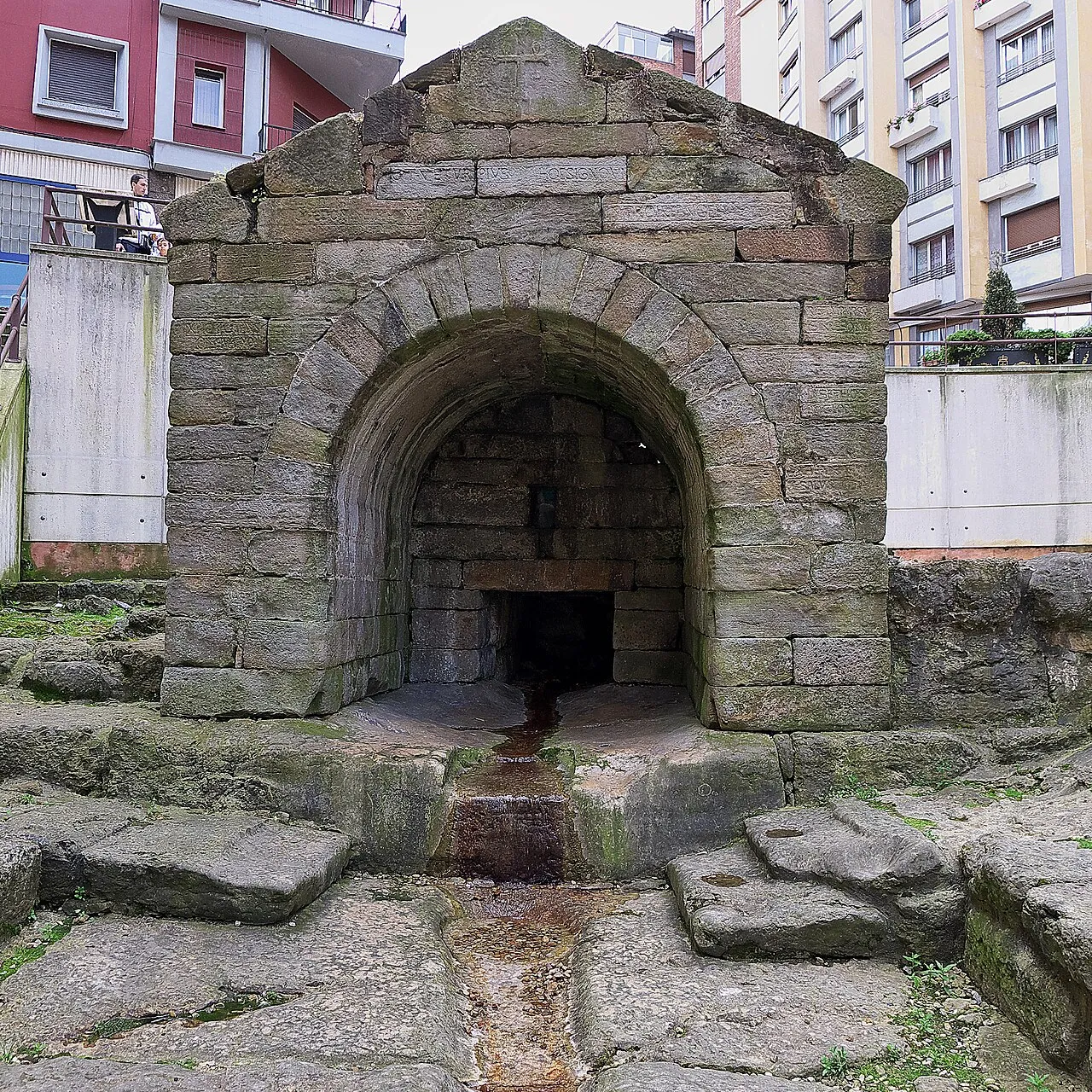
A ninth-century fountain that still works: the only surviving civil work for public use from the whole of the European Early Middle Ages.
Download the app and discover Oviedo offline, whenever you like. Take the walking tour The University, Santullano and old Vetusta with a local guide in your ear.
Find out more about Viavoy →San Julián de los Prados — Santullano to the people of Oviedo — is the largest surviving church of the Asturian Pre-Romanesque. Alfonso II built it at the beginning of the ninth century, with his trusted architect, Tioda.
Outside it is plain, solid stone, almost without ornament. Inside it is entirely painted in fresco, with illusionistic architecture, hangings and geometric motifs, and not a single human figure anywhere in it.
That total absence of figures is what makes it exceptional and what has fed decades of debate: aniconic influence, an inheritance from Roman painting of illusionistic architecture, or a deliberate theological decision. There is no consensus.
What is beyond dispute is the scale and the state of conservation: it is the most important group of Pre-Romanesque wall painting in Europe, and the reason it has been a World Heritage Site since 1998. It also has a secret chamber above the crossing whose function is still argued over.
La Foncalada looks like a little chapel crouching on the ground, and it is unique in the world for a very specific reason: it is the only civil work for public use surviving from the whole of the European Early Middle Ages.
From that period churches have come down to us, and the odd remnant of a palace, because those were the buildings power considered worthy of stone. A piece of public infrastructure meant to give water to ordinary people, preserved and in working order, exists nowhere else.
Alfonso III the Great had it completed over a natural spring, although its origin goes back to the time of Alfonso II. It stood outside the walls, beside the old road, so that travellers arriving in Oviedo could drink.
Carved on it is the Cross of Victory with the letters alpha and omega and a Latin inscription which says, more or less, “with this sign the pious are protected, with this sign the enemy is defeated”. It was a fountain and a talisman at the same time.
The original cross, of gold and precious stones, made around the year 908 to the order of Alfonso III himself, is kept in the Cámara Santa, the holy chamber, of the cathedral. It is today the symbol on the flag and the coat of arms of Asturias.
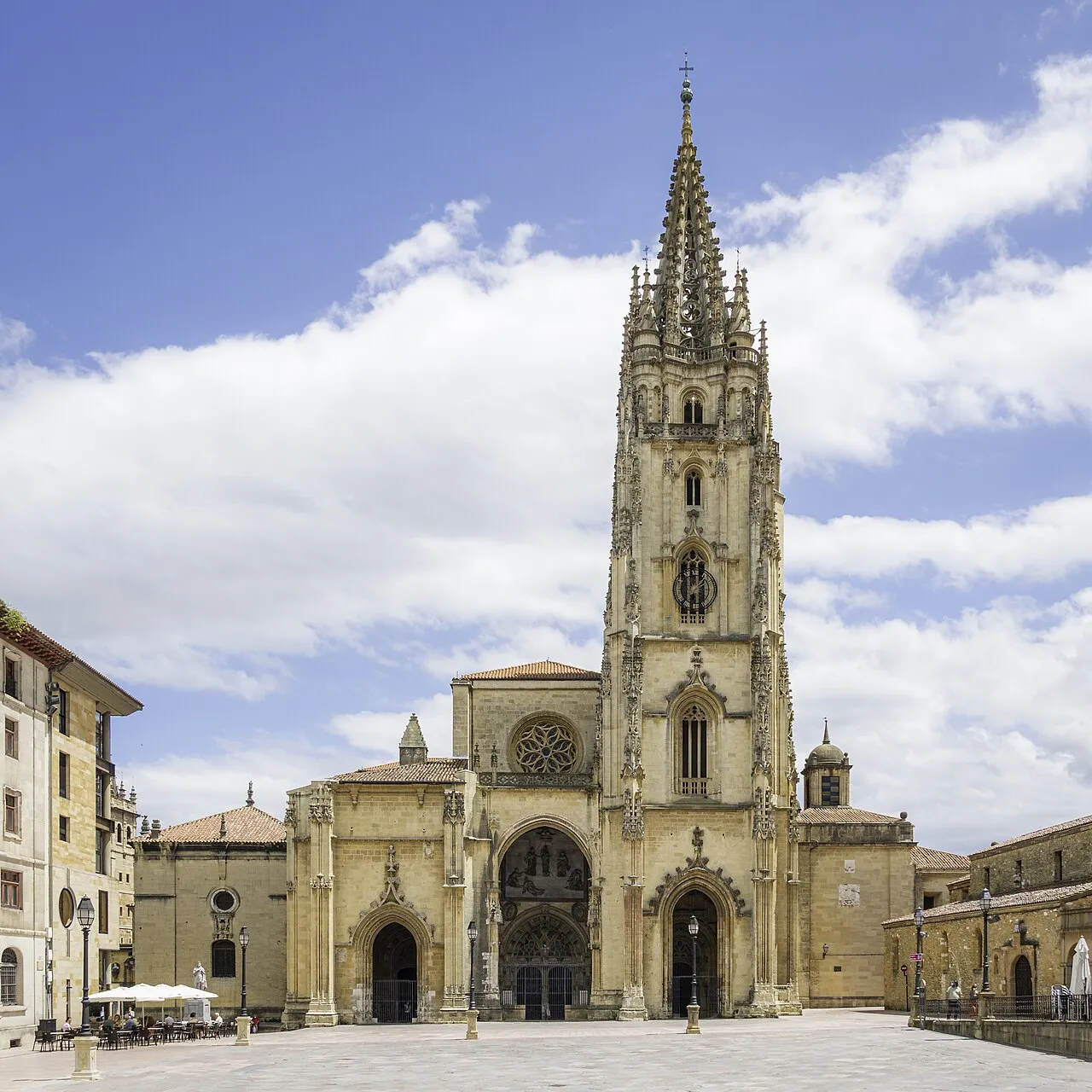
Its Cámara Santa holds the Cross of Victory, the Cross of the Angels and the Arca Santa. They were blown up with dynamite in 1934 and restored from the fragments.
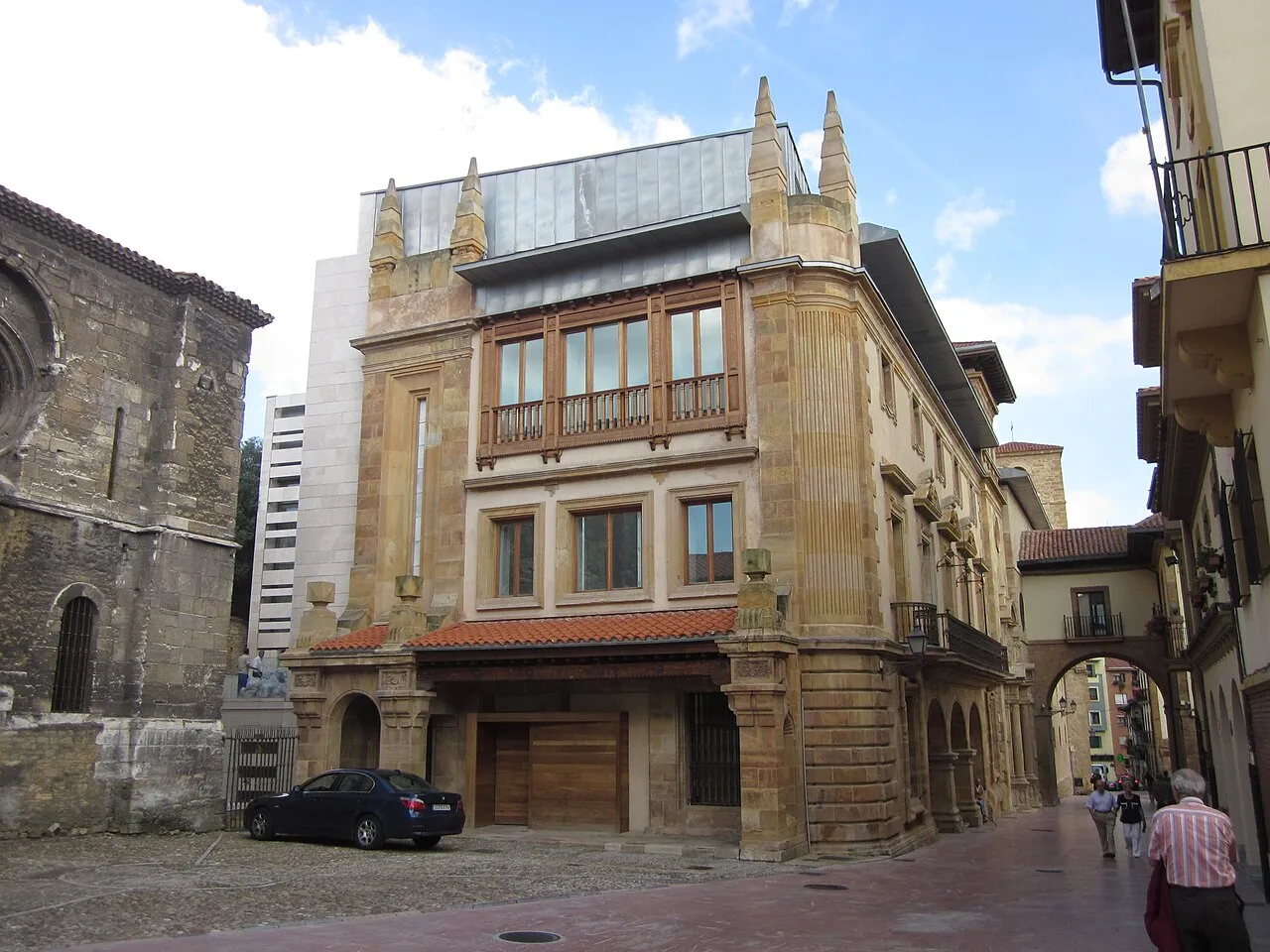
It holds reliefs and stone lattices from Pre-Romanesque buildings that no longer exist. Free entry, and in the monastery where the city was born in 761.
The court art of the kingdom of Asturias between the eighth and tenth centuries, developed when half the peninsula was under Muslim rule. It is a style of its own, with no exact equivalent in Europe, with singular constructive and decorative solutions. Its main monuments are World Heritage Sites.
That is the great question and there is no consensus. Aniconic influence has been proposed, a direct inheritance from Roman painting of illusionistic architecture, or a deliberate theological decision by the court of Alfonso II. What is painted is buildings, hangings and geometric motifs, and not a single person appears.
Because it is the only civil work for public use surviving from the whole of the European Early Middle Ages. From that period churches have come down to us, and the odd remnant of a palace, but a piece of public infrastructure meant to give water to ordinary people, preserved and still working, exists nowhere else.
The king who turned Oviedo into the capital of the kingdom of Asturias. He reigned for more than fifty years, from 791 to 842, one of the longest reigns of the Middle Ages in the peninsula, and that span allowed him to build a whole capital. They called him “the Chaste” because he never married and left no descendants.
Yes, the first documented one. In the ninth century Alfonso II went in person from Oviedo to pray before the newly discovered tomb of the apostle. His route is today called the Camino Primitivo, it is the oldest of them all and it entered the UNESCO World Heritage list in 2015, within the Routes of Northern Spain.
A jewel of gold and precious stones made around the year 908 to the order of Alfonso III the Great, kept in the Cámara Santa of the cathedral. It is today the symbol on the flag and the coat of arms of Asturias, and its design appears carved in the stone of La Foncalada as a protective talisman for the water.
On Monte Naranco, on the edge of the city, stand Santa María del Naranco and San Miguel de Lillo, two jewels of the style also World Heritage Sites, with views over Oviedo. You get there by bus or with a long walk uphill, and they deserve half a day.
Download Viavoy and walk Oviedo offline, whenever you like.

Keep reading