Visiting the Guggenheim in Bilbao: what to see inside and out
How a building that could not be drawn was built, which room justifies the ticket and everything you can see free around it. With the effect that carries its name in the town-planning textbooks.
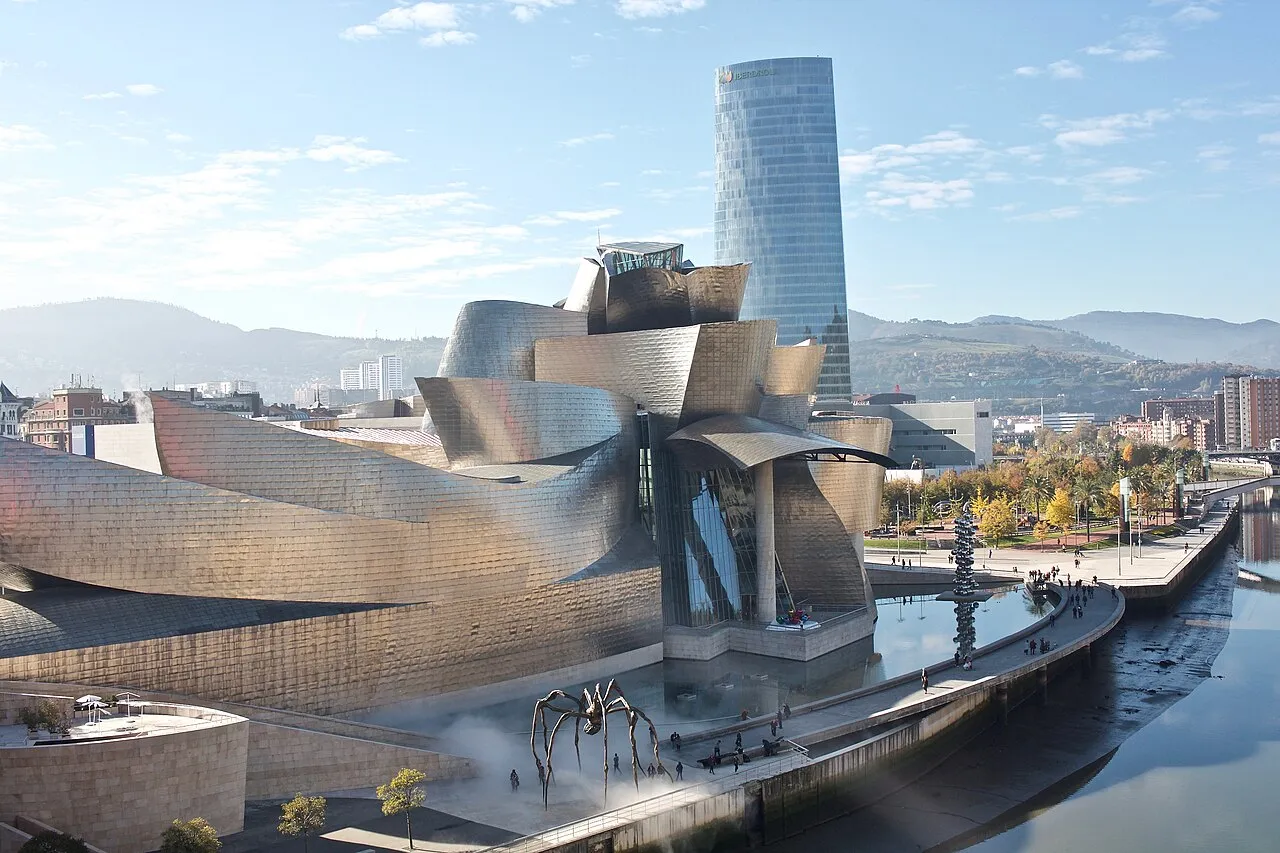
When Frank Gehry presented the project, in a city of shipyards in crisis with mass industrial unemployment, a lot of people thought that spending all that on a strange building was madness. It opened in October 1997 and within two years it had changed the international perception of Bilbao. Today the phenomenon has a name of its own and is studied in universities: the Guggenheim effect.
Everything around the museum is free and can be seen at any hour: Puppy, Maman, Buren's red arch under the La Salve bridge and the fog installation that wraps the base of the building every so often.
A building that could not be drawn
Titanium, scales and fighter-jet software.
Gehry works with models of card and paper twisted by hand, forms that admit no plan, elevation or section in the conventional sense. To get from there to something buildable they used CATIA, a program developed in France to design fighter jets, which digitised the models and generated the breakdown of every piece.
The cladding is some thirty-three thousand titanium sheets half a millimetre thick, mounted overlapping like scales and slightly rippled so that none of them is perfectly flat. That detail is what makes the façade vibrate instead of reflecting like a mirror, and what explains why it changes colour with every cloud.
Titanium, moreover, was not an aesthetic decision from the start. The project called for stainless steel, and a fall in the market price of titanium made the change viable. A building now synonymous with architectural luxury was clad this way because of a buying opportunity.
The interior turns around an atrium some fifty metres high, with walkways and glazed lifts, off which the galleries open on three levels. It is the point where the building explains itself better than in any photograph.
Opened in October 1997, the work of Frank Gehry. Booking a time slot is strongly advisable in high season. Closed on Mondays except in summer. Entry is around 16 € and covers the temporary shows and the collection; allow two and a half hours if there are two big installations.
Richard Serra's spirals of rusted steel, installed permanently in a gallery some one hundred and thirty metres long built to their measure. You walk through them from the inside, and the physical disorientation of walking between those leaning walls is exactly the work. It would not fit in almost any other museum.
It is worth saying it plainly: the museum's own collection is relatively modest and rotates often. What justifies the ticket is two things, the Richard Serra gallery — which is permanent — and the large-format temporary exhibitions, which fit here because the building was designed for exactly that.
So look at the programme before you buy. There are seasons with two powerful installations and transitional seasons in which half a floor is being fitted out. The difference between one visit and another is considerable, and the price is the same.
Inside the building, besides the galleries, it is worth stopping in the atrium and going up to the upper walkways: from there you understand how the volumes fit together and you see the great window that frames the La Salve bridge, which Gehry built into the museum instead of dodging it.
Two and a half hours is a realistic estimate with two exhibitions. With only one, a good hour and a half. The museum is not enormous: what tires you is the scale of the works, not the distance.
Everything you can see without paying
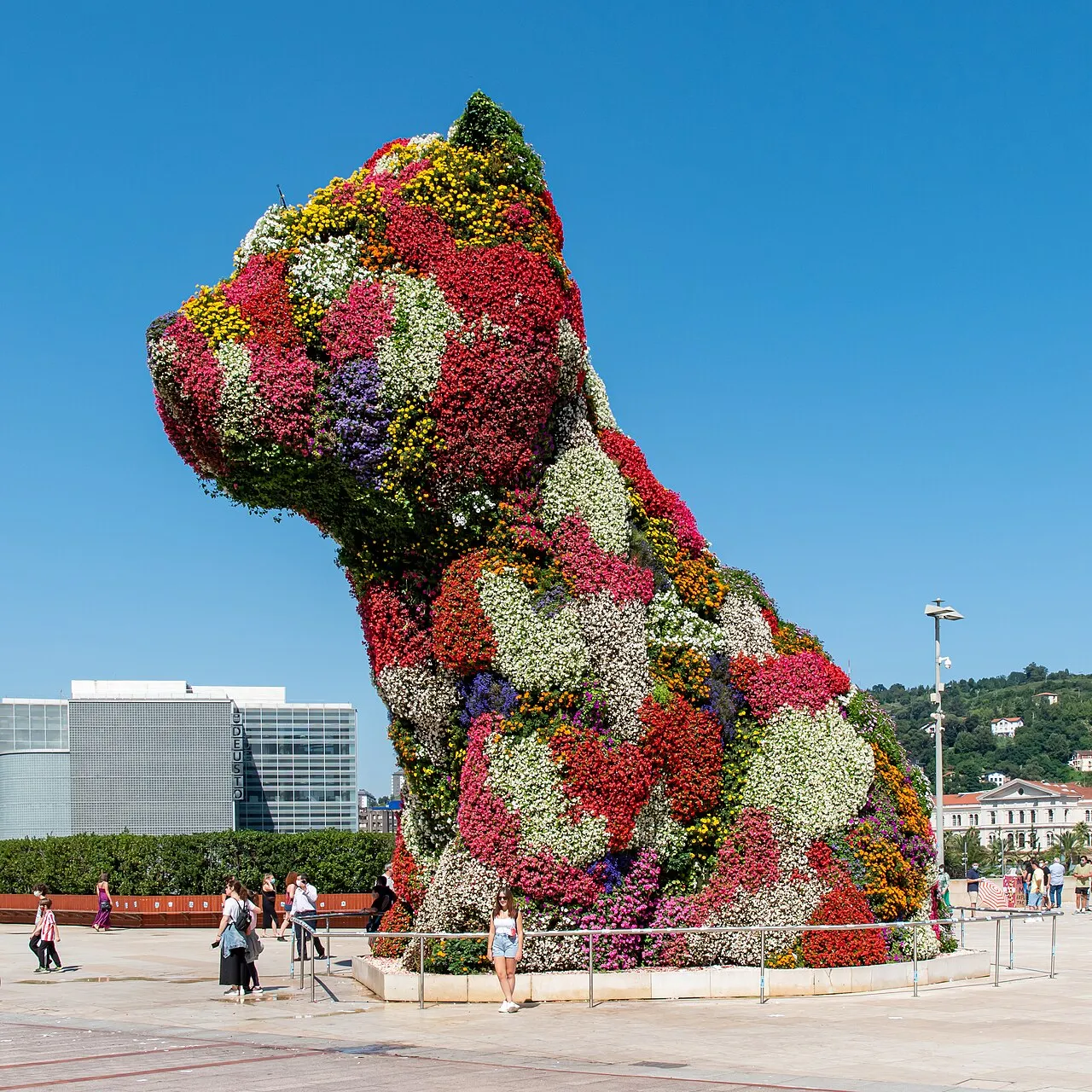
The exterior is a visit in itself and costs nothing. Puppy, Jeff Koons's thirteen-metre dog made of living flowers, watches over the steps on the city side, and is replanted twice a year, so its colour changes with the season.
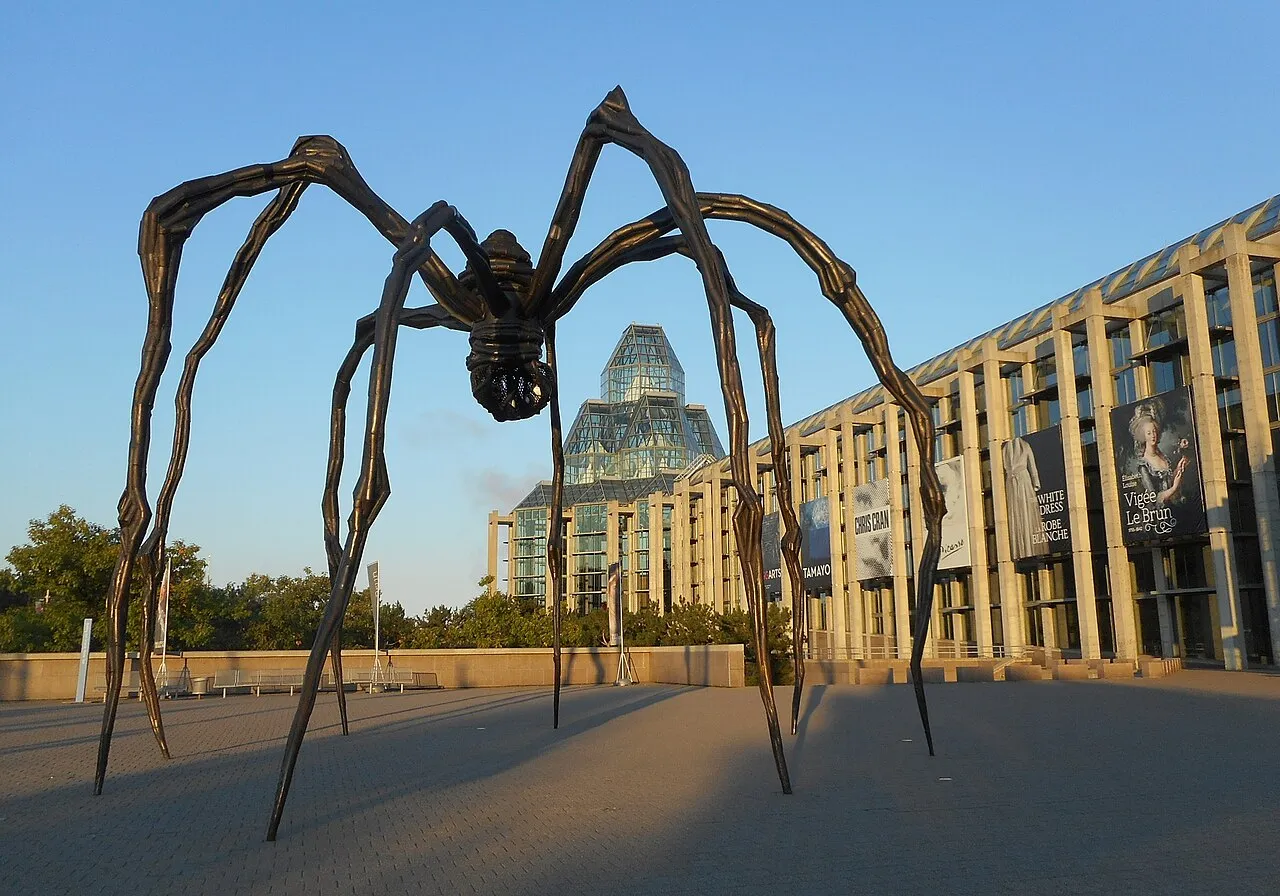
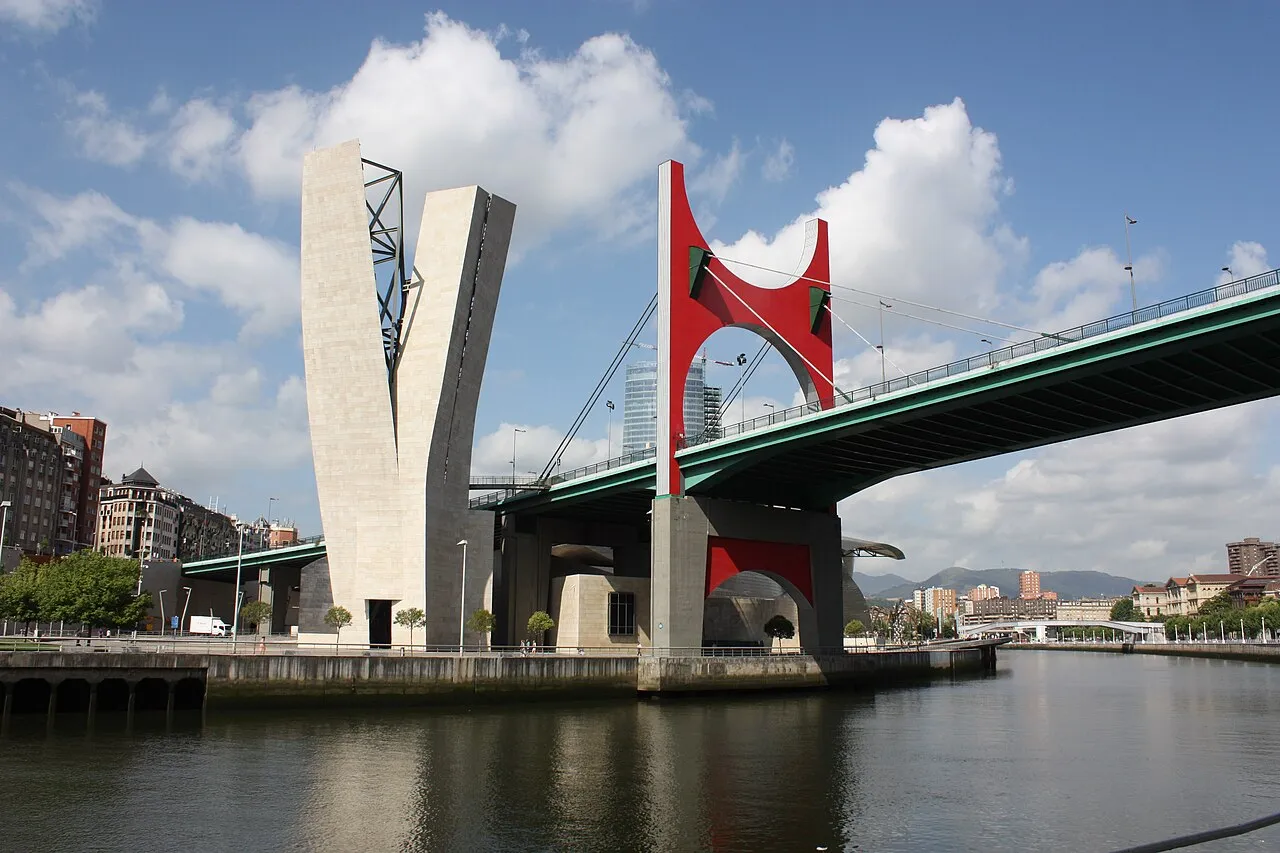
On the lower terrace, beside the water, stands Maman, Louise Bourgeois's nine-metre spider, with twenty marble eggs hanging in the sac between its legs. And under the La Salve bridge rises a large red arch by Daniel Buren, the same artist as the coloured cube at the Pompidou in Málaga.
There are also two pieces many people do not identify as works: Koons's Tulips, a metallic bunch of coloured flowers on the terrace, and the fog installation by the Japanese artist Fujiko Nakaya, which every so often wraps the base of the building in thick mist for a few minutes. It is not damp off the estuary: it is programmed.
The best moment for all of this is dusk, when the titanium turns golden, and night, with the building lit up and reflected in the water. Walking right round it takes about thirty minutes.
Tens of thousands of living flowers on a steel structure with drip irrigation. It predates the museum: it was first shown at a German castle, passed through Sydney and arrived here as a temporary loan that was never returned. Beside it, the plaque that remembers the ertzaina Txema Agirre, the Basque police officer.
Bronze, steel and twenty eggs of white and grey marble. Bourgeois conceived it as a portrait of her mother, a restorer of tapestries, and wanted the viewer to pass underneath to feel shelter and threat at the same time. It has sisters in London, Ottawa and Tokyo; this one has the best setting.
Gehry did not dodge the bridge that crossed the site: he built it into the museum. Years later, Daniel Buren added the great red arch that identifies it today. From underneath you get one of the least photographed and most interesting perspectives of the whole thing.
How much does entry to the Guggenheim in Bilbao cost?
Around 16 € for the standard ticket, with reductions for students, older visitors and the unemployed, and free for children. It works by time slots and it is worth booking in high season and at weekends. The ticket includes the temporary exhibitions and the collection, including Richard Serra's permanent gallery.
What must you see inside?
“The Matter of Time”, by Richard Serra, in the long gallery of the east wing: spirals of rusted steel you walk through from the inside, in a space built to their measure. And the fifty-metre atrium with its walkways, from where you understand how the volumes of the building fit together better than in any photograph.
Is it worth going in or is seeing it from outside enough?
It depends on the programme. The exterior is free, spectacular and has four first-rate works around it. Inside, what justifies the ticket is the large-format temporary shows and the Serra gallery. If there is little on during your dates, seeing the building from outside and giving the time to the Museum of Fine Arts is a reasonable option.
Why is it made of titanium?
The original project called for stainless steel, but a fall in the market price of titanium made the change viable. Some thirty-three thousand sheets half a millimetre thick were used, mounted like scales and slightly rippled so that none of them would be flat: that is why the surface vibrates and changes colour with the light.
What is the Guggenheim effect?
The name given in town planning to the idea that a single highly ambitious cultural bet can transform the image and the economy of an entire city. Bilbao is the founding case and the most quoted one, and dozens of cities have tried to repeat it with very uneven results, which has fed a long debate about its limits.
Is the fog at the museum real?
It is a work of art. The Japanese artist Fujiko Nakaya installed a hidden system that every so often wraps the base of the building in a thick fog rising off the water. For a few minutes the titanium seems to float among clouds. It has nothing to do with the damp of the estuary, however much it looks like it.