Ronda was Muslim for almost eight centuries and fell on 22 May 1485, after a short but decisive siege. What is striking is how much survived that date: baths that are among the best preserved in Europe, a stairway cut into the cliff that explains why the city fell, a mihrab inside a church and palaces where nobody erased what came before.
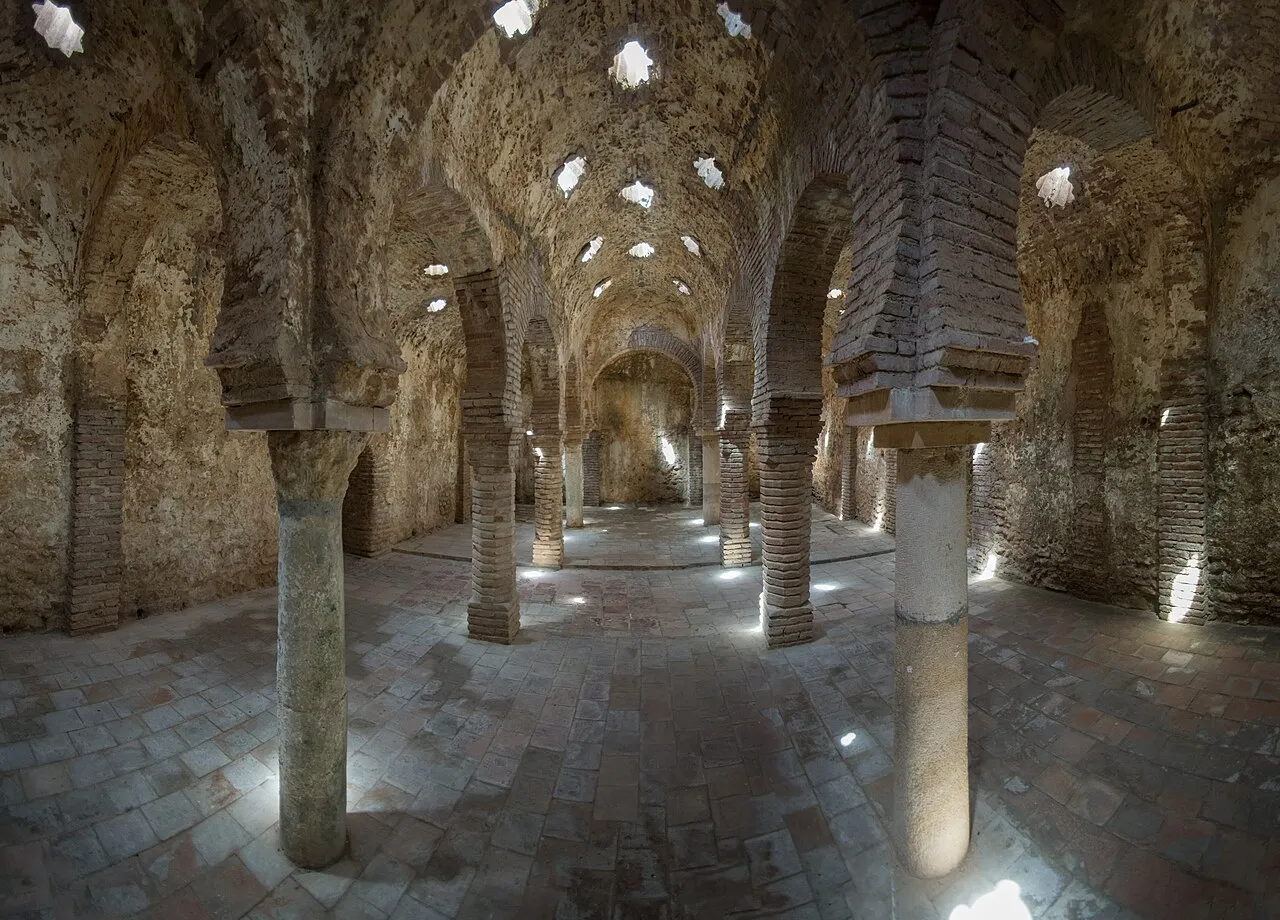
The Arab Baths survived because the Christians stopped using them: the building was abandoned and ended up as a tannery. That neglect is the reason they have come down to us almost intact.
The baths, and why they are still standing
Late thirteenth century, beside the stream.
They are down below, beside the stream and the old tanners' quarter, and that position is no accident: the water had to arrive by gravity. A waterwheel raised water from the channel to a tank, and from there it was distributed to the rooms through conduits.
A hammam was not just a place to wash. Before entering the mosque you had to purify yourself, so it served a religious function; but above all it was a social institution where deals were closed and marriages arranged amid the steam. Half temple and half public square.
The layout is the classic one and you walk it in the order the user did: cold room, warm room and hot room, with progressive changes of temperature. It is the system of the Roman baths, inherited and adapted, hypocaust included: a furnace heated air that circulated under the floor on small pillars and rose up through the walls.
What impresses most are the vaults, pierced by dozens of skylights in the shape of eight-pointed stars. They are not decorative: they regulated the light coming in and the steam going out. With the rooms dry, today they project constellations of dots across the floor.
Fifteen minutes downhill from the Puente Nuevo, and the climb back up is a serious one. Entry is very cheap and included in the municipal combined ticket. The explanatory film is welcome: without context, the building can look like nothing more than a set of empty vaulted rooms.
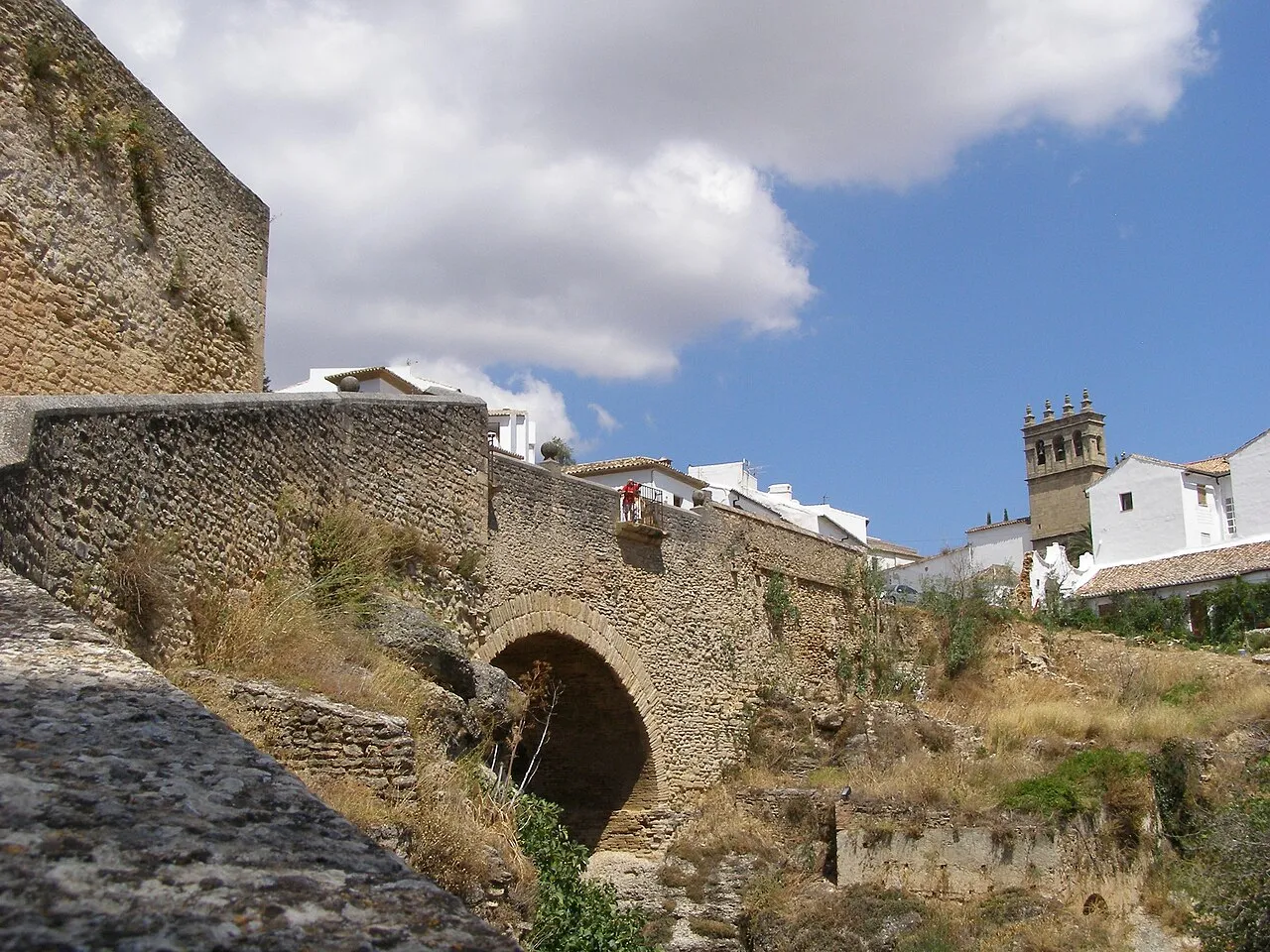
The oldest of Ronda's three bridges, of Andalusi origin, over the arroyo de las Culebras. Beside it stood the water gate of the walled enclosure. It is the lowest point in the city and the climb back up to the old town starts there.
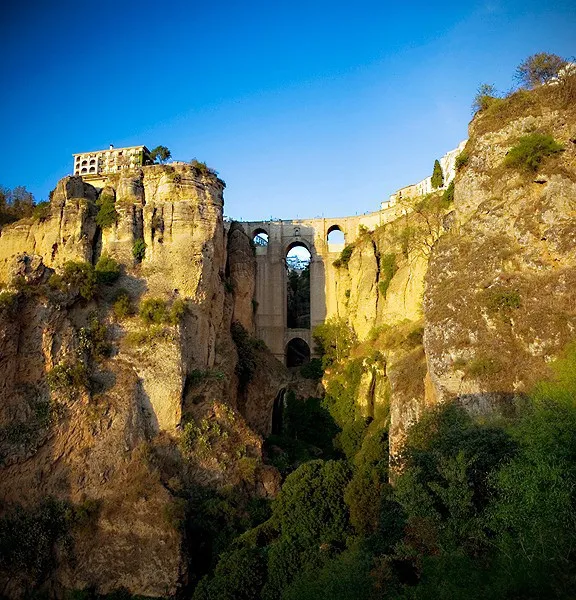
Ronda is impregnable by position: a city above a hundred-metre gorge cannot be taken by storm. But it has an obvious structural problem, which is that the water is down below. Solving that was the key to any long defence.
In the fourteenth century the Nasrid king Abomelic ordered a secret stairway to be cut into the living rock, running down from the Casa del Rey Moro to the river, more than two hundred steps inside the cliff. Water was carried up it in human chains, in leather skins, day and night. The chronicles say it was done by chained Christian captives, which is why it is also known as the stairway of the slaves.
In the siege of 1485 the troops of the Marquis of Cádiz cut off access to that mine, and without water Ronda fell in a matter of days. No wall held out: the city was lost over a supply problem.
Today you can go all the way down, and it is the most impressive visit in Ronda. But be aware that it is more than two hundred irregular steps, damp and slippery, down and back up, with no alternative and no lift. It is not suitable for anyone with mobility problems.
What survived up top
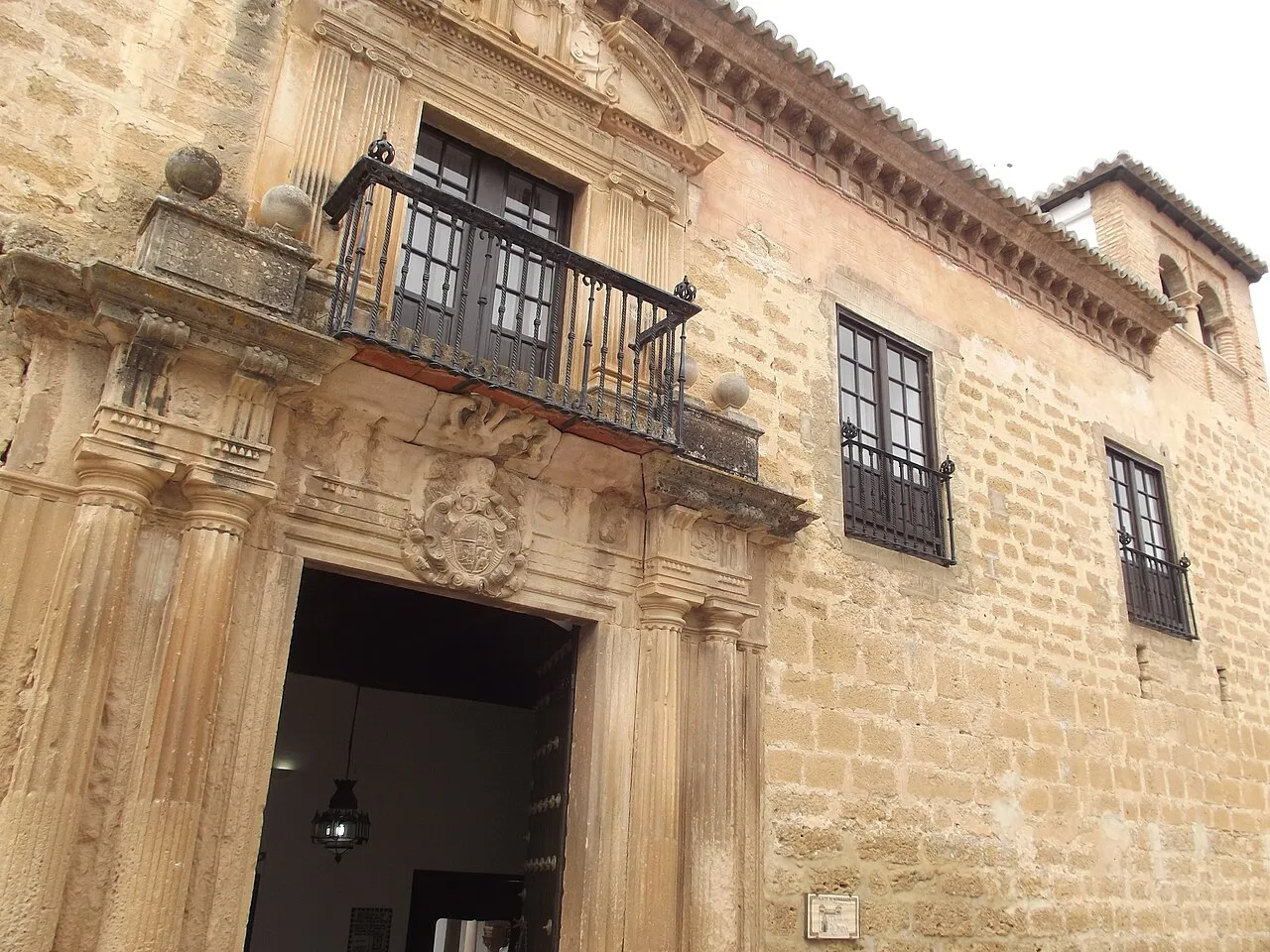
In the old town more remains survive than you would think. The Palacio de Mondragón was the residence of the Nasrid governor and keeps Andalusi courtyards with horseshoe arches, Mudéjar coffered ceilings and plasterwork, beneath doorways that are already Renaissance. Nobody erased what came before: they kept adding on top.
In Santa María la Mayor, raised exactly over the main mosque, the arch of the mihrab survives in its original place, inside the church. The orange-tree courtyard occupies the old sahn used for ablutions, and the bell tower was raised on the shaft of the minaret.
The Casa del Gigante is a fourteenth-century Nasrid palace house, small and very little visited, with a courtyard, plasterwork and original coffered ceilings. It is one of the few Andalusi houses preserved in Andalusia outside Granada, and it gives a very direct idea of how people lived here.
And there is the Puerta de Almocábar, with its three bent-entrance arches between two round towers, through which the Castilian troops came in. Above it, the imperial eagle placed there by Charles V when he had it remodelled. Read in that order, the ensemble tells the whole story without needing a sign.
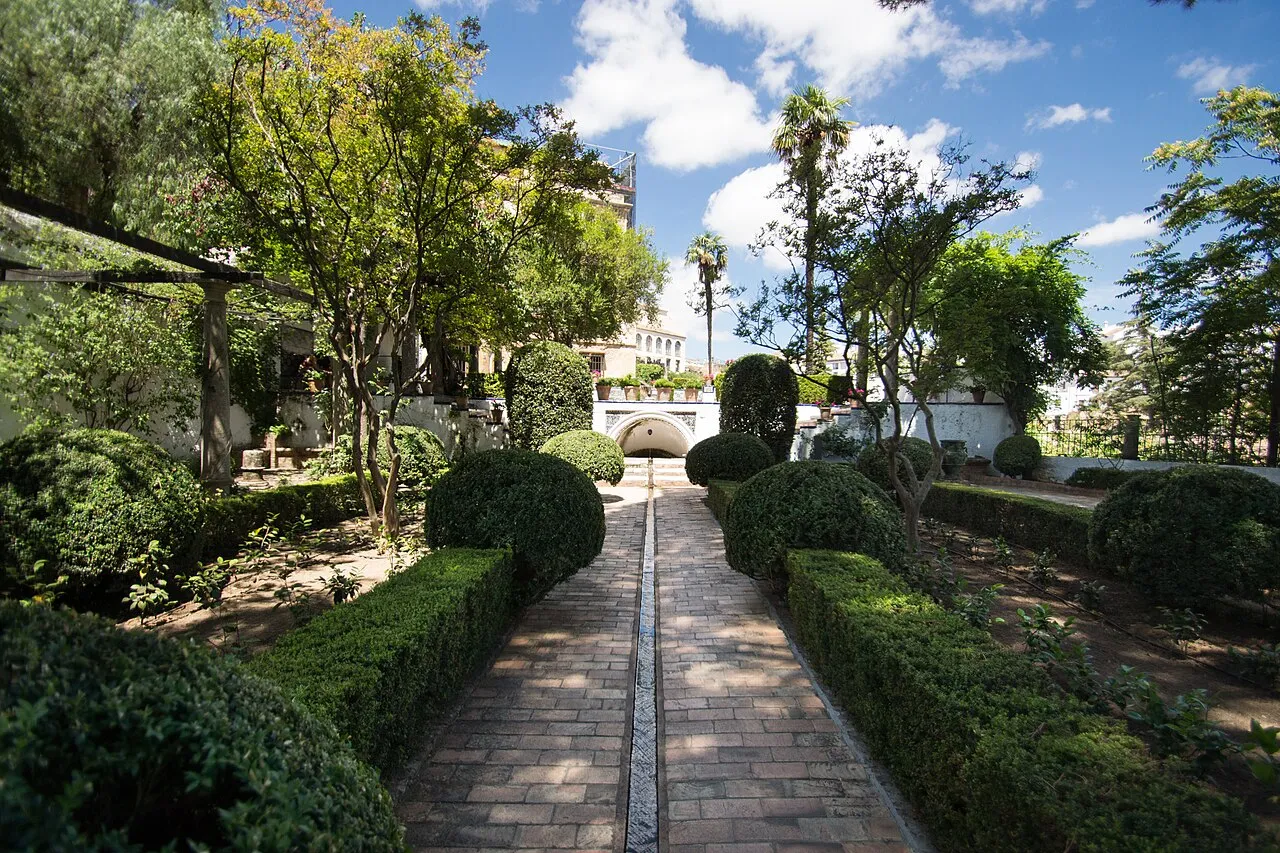
The name lies twice: the building is not that old and no Moorish king ever lived here. But the fourteenth-century mine is real, and with it the terraced gardens Forestier designed in 1912 above the ravine, with a side view of the Puente Nuevo that no other spot offers.
A Mudéjar courtyard with horseshoe arches and tiles, and twenty paces away a Castilian courtyard of classical proportions: two cultures without leaving the building. Its hanging gardens at the back are included in the ticket and give the best view of the Serranía.
Why are the Arab Baths of Ronda so well preserved?
Paradoxically, through neglect. After the conquest of 1485 the Christians looked on these buildings with suspicion, stopped using them and the complex ended up turned into a tannery. That disuse, which at the time was contempt, is what has allowed them to come down almost intact and to pass today as the best preserved in Europe.
What are the star-shaped skylights?
The eight-pointed star-shaped holes that pierce the vaults. They are not decorative: they regulated the light coming in and the steam going out in each room. With the bath in operation they produced columns of light cutting through the hot mist; today, with the rooms dry, they project constellations across the floor.
How did Ronda fall in 1485?
Over water. The city is impregnable by its position above a hundred-metre gorge, but the water is down below, and it was brought up by a secret stairway cut into the cliff in the fourteenth century. When the troops of the Marquis of Cádiz cut off access to that mine, the city fell in a matter of days without a single wall being brought down.
Can you go all the way down the mine?
Yes, it is part of the visit to the Casa del Rey Moro. It is more than two hundred irregular steps, damp and slippery, cut into the rock, down and back up, with no lift and no alternative. It is not suitable for anyone with mobility problems, and footwear with grip is advisable. In exchange, it is the most impressive thing in the city.
What is left of Muslim Ronda besides the baths?
The arch of the mihrab preserved in place inside the church of Santa María la Mayor, the Andalusi courtyards and coffered ceilings of the Palacio de Mondragón, the Casa del Gigante — a fourteenth-century Nasrid palace house —, the Puerta de Almocábar with its bent-entrance arches and several stretches of wall, as well as the Puente Árabe de San Miguel.
In what order is it best to see it?
From top to bottom, letting gravity help: from the Puente Nuevo, the Casa del Rey Moro with the mine, then the Puente Viejo and the Arab bridge of San Miguel, and finally the baths at the lowest point. The way back is all uphill, so it is best done in the cool of the morning or at sunset.
Practical information
The bathsCalle San Miguel, lower part of town. Entry very cheap, included in the municipal combined ticket.
The mineIn the Casa del Rey Moro. More than two hundred damp steps, down and back up.
Remains up topThe mihrab in Santa María, Nasrid courtyards in Mondragón and the Casa del Gigante.
RouteFrom the bridge downwards: Rey Moro, Puente Viejo and the baths. The way back is all uphill.
DurationA long half day if you do the mine and the baths.
FootwearWith grip: the mine and the canyon paths are damp and uneven.
On the map
🎧 With Viavoy
Walk Ronda and listen at your own pace
Download Viavoy and walk Ronda offline, whenever you like.