1
Paseo Marítimo
📍 Bay of Palma
The axis from which you reach the whole coastal front of the city, by bike or on foot. To the east are the city beaches and Portitxol; to the west, Porto Pi, Cala Major and the way out towards the western coast.
From the city beach you reach by bus to the coves of the Tramuntana and the south-east. Which ones need a car, which ones fill up and when to go.
🎧 On the walk Santa Catalina, the market and Es JonquetPalma is a port city that faces inland: it has the sea in front of it, but its city beach is not what people picture when they think of Mallorca. The good stuff is between twenty minutes and an hour away by car, and the choice depends a lot on what kind of swim you are after, because the north and the south of the island are nothing like each other.
Palma has its own city beaches at Can Pere Antoni and Ciutat Jardí, east of the Paseo Marítimo, reached on foot or by city bus. They are sandy, with a promenade, and they are fine for a quick swim, but they have the road behind them and they are not the reason anybody comes to Mallorca.
A little further on, Es Molinar and Portitxol form a stretch of low houses and restaurants beside the water that was the city's old fishing quarter. It is more interesting as a walk and as a place to eat than as a beach.
And to the west, past the harbour, are Cala Major and Sant Agustí, which the city bus reaches. They are surrounded by hotels and dense building, so the experience is that of a resort city beach.
The honest conclusion: if you have a single day, give it to the city. Palma's city beaches do not compare with what there is half an hour away.
The axis from which you reach the whole coastal front of the city, by bike or on foot. To the east are the city beaches and Portitxol; to the west, Porto Pi, Cala Major and the way out towards the western coast.
Download the app and discover Palma offline, whenever you like. Take the walking tour Santa Catalina, the market and Es Jonquet with a local guide in your ear.
Find out more about Viavoy →The bay of Palma closes off to the east with Platja de Palma and S'Arenal, six kilometres of fine sand and shallow water with every piece of tourist infrastructure imaginable. There is a bus from the centre and it is the easiest option without a car, but it is on a mass scale.
Beyond that, in the south-east of the island, are the coves that turn up in the photographs: Es Trenc, with dunes and no building, considered one of the best beaches in the Mediterranean; Cala Pi, wedged between rock walls; Es Carbó and Ses Roquetes, in the Es Trenc-Salobrar nature park.
Es Trenc is about forty minutes from Palma and needs a car. It is a protected beach, with no building, paid parking and no services beyond a couple of chiringuitos. In July and August it fills up, so you have to get there early.
Further east, the Santanyí area holds Cala Mondragó, Caló des Moro and Cala S'Almunia, which are the postcard turquoise coves. They are a good hour away, the access is difficult and the parking limited, and in summer the numbers have turned them into a real local problem.
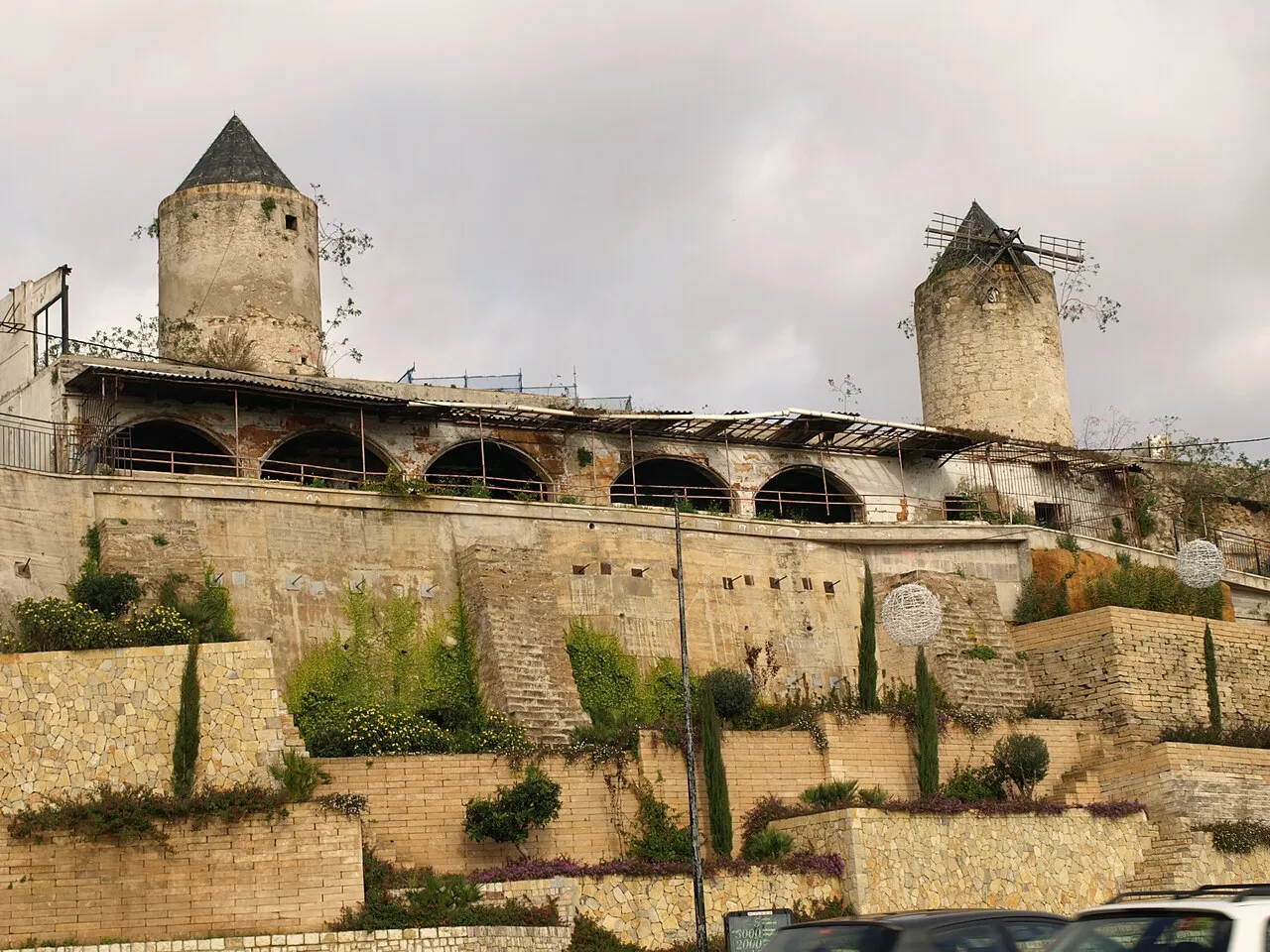
Before leaving the city, this mound with its flour windmills gives the best perspective on the bay. It is the point where Palma's relationship with the sea makes sense: the fishermen's quarter looking at the water that fed it.
Yes: Can Pere Antoni and Ciutat Jardí, sandy and reachable on foot or by city bus, and Cala Major and Sant Agustí to the west. They are fine for a quick swim but they have the road or the buildings behind them. If you only have one day, give it to the city: the city beaches do not compare with what there is half an hour away.
It depends on what you are after. For sand and turquoise water, Es Trenc, about forty minutes away: protected, with no building and considered one of the best in the Mediterranean. For a rocky cove with mountain behind, the coast of the Serra de Tramuntana. They are two completely different experiences.
Yes. Platja de Palma and S'Arenal have a bus from the centre, as do the city beaches and Cala Major. And there is a better option: the wooden train to Sóller leaves from the centre of Palma itself, crosses the Serra de Tramuntana and connects with a tram down to the Port de Sóller. Half a day without a car and with a beach at the end.
A protected beach inside the Es Trenc-Salobrar nature park, with dunes, no building and very shallow water that gives it that turquoise colour. It has paid parking and very few services beyond a couple of chiringuitos. In July and August it fills up, so it is worth getting there early.
Cala Mondragó, Caló des Moro and Cala S'Almunia are spectacular, but it is worth knowing what you are in for: they are a good hour from Palma, the access is difficult, the parking is very limited and the summer numbers have turned into a real local problem. Outside high season, the experience changes completely.
The south and south-east have beaches of fine sand, shallow water and turquoise colour, with more services and more people. The north and the west are the Serra de Tramuntana: cliffs, coves of rock or shingle, deep water straight away and narrow, twisting roads. The landscape is far more spectacular and the swimming more demanding.
The western and northern coast is something completely different. The Serra de Tramuntana, a World Heritage Site, drops into the sea in cliffs, and the coves are of rock or shingle, with deep water straight away and mountain behind.
The most accessible from Palma are Portals Vells and El Mago, half an hour to the south-west, and Camp de Mar and Sant Elm, a little further. To the north, Cala Deià and the Port de Valldemossa call for narrow, twisting roads, but the landscape makes up for it.
Sa Calobra and the Torrent de Pareis are the spectacular destination in the sierra, on a road famous for its impossible layout. It is a good hour and a half from Palma and it is a full-day excursion, not a beach plan.
And there is an alternative many people do not consider: the wooden train to Sóller leaves from the centre of Palma itself, crosses the sierra and connects with a tram down to the Port de Sóller. It is a half-day plan without a car and with a beach at the end.
Download Viavoy and walk Palma offline, whenever you like.

Keep reading