Cáceres in a day: an itinerary through the monumental city
A walled complex you can walk end to end in a couple of hours, two interiors worth the entrance fee, and an end to the day you should save for after dark.
Cáceres is a small city with a monumental old town of about ten hectares, so a day is more than enough to see it. What sets it apart is not the size but the integrity: inside the walls there is no advertising, no overhead cabling, no modern street furniture, and hardly anyone lives there. It is one of the few Spanish cities where you can walk the whole route without having to dodge a thing.
Save the night. The monumental complex is floodlit and left practically empty, while the Plaza Mayor stays full. That contrast is the best image the city gives you, and it is free.
Morning: the square, the tower and the way into the complex
Two hours.
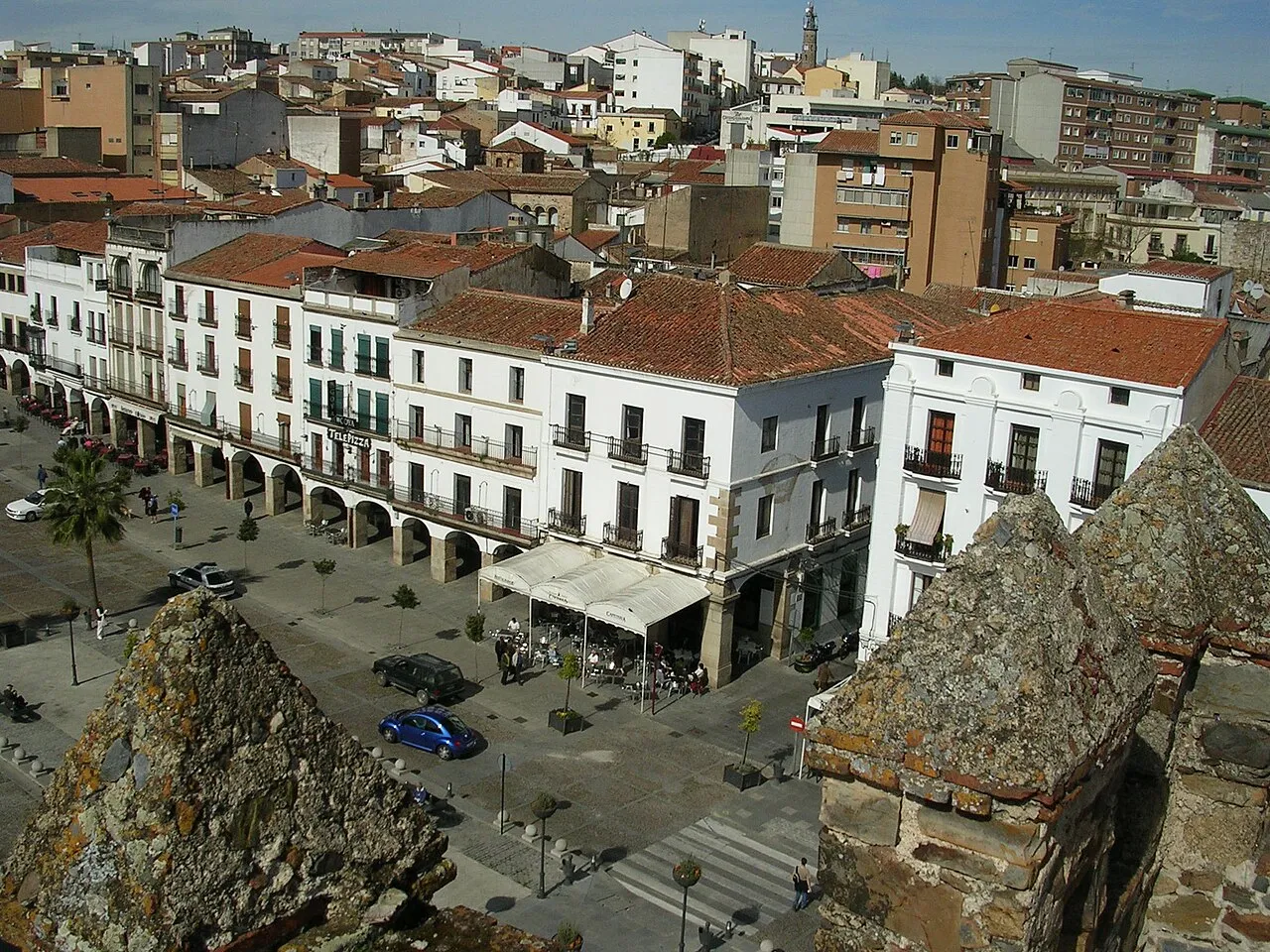
Start in the Plaza Mayor, which lies outside the walls and is where the city actually lives. It is a sloping square, with continuous arcades on two sides, and at the far end a stone wall with towers behind it that gives nothing away. That wall is the border between the two Cáceres.
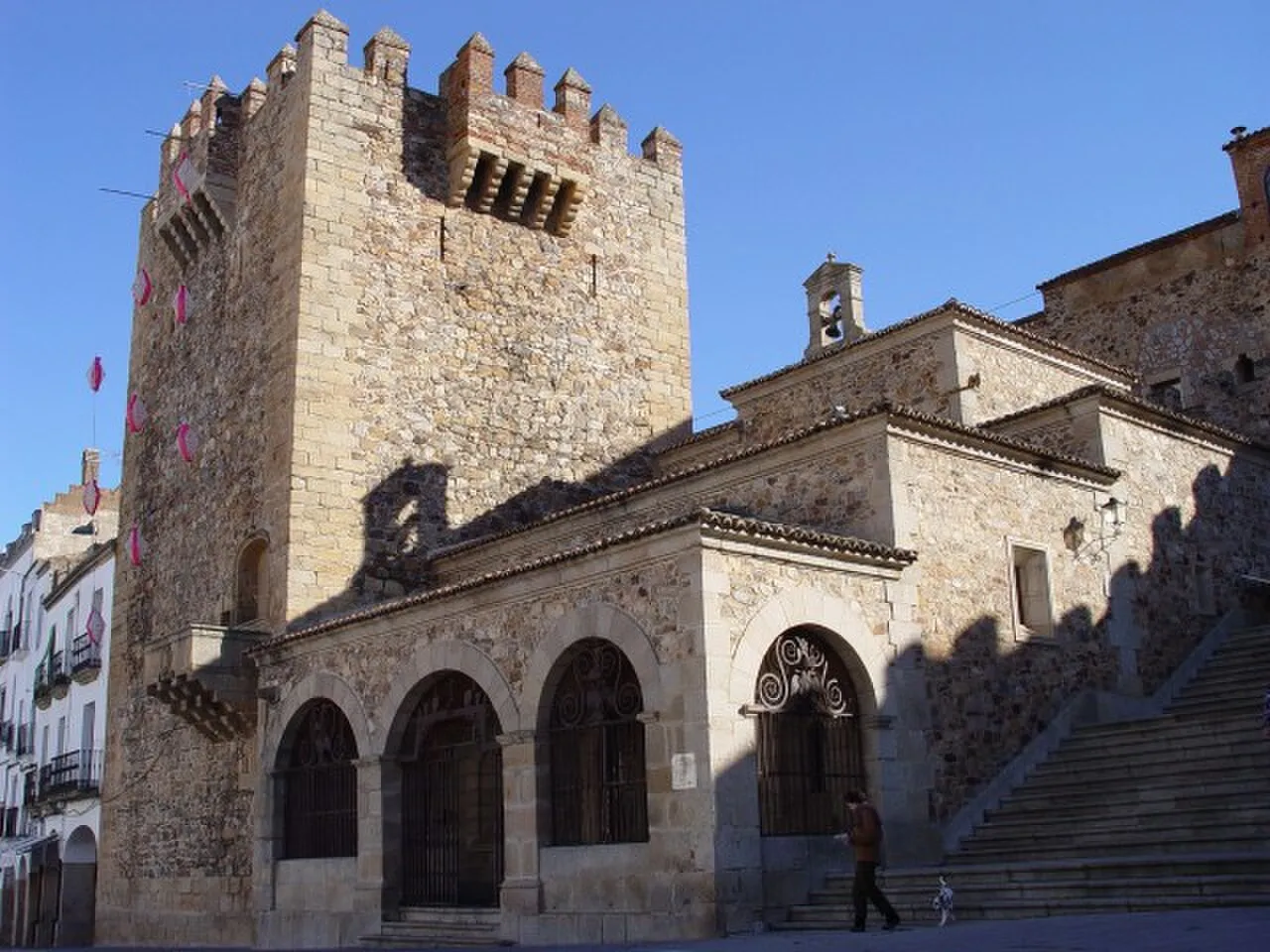
Go up the Torre de Bujaco first, which presides over the square. Inside there is a short interpretation centre and a terrace that commands the whole complex: it is the most efficient way to order your day, because from up there you can pick out every point you are going to walk later.
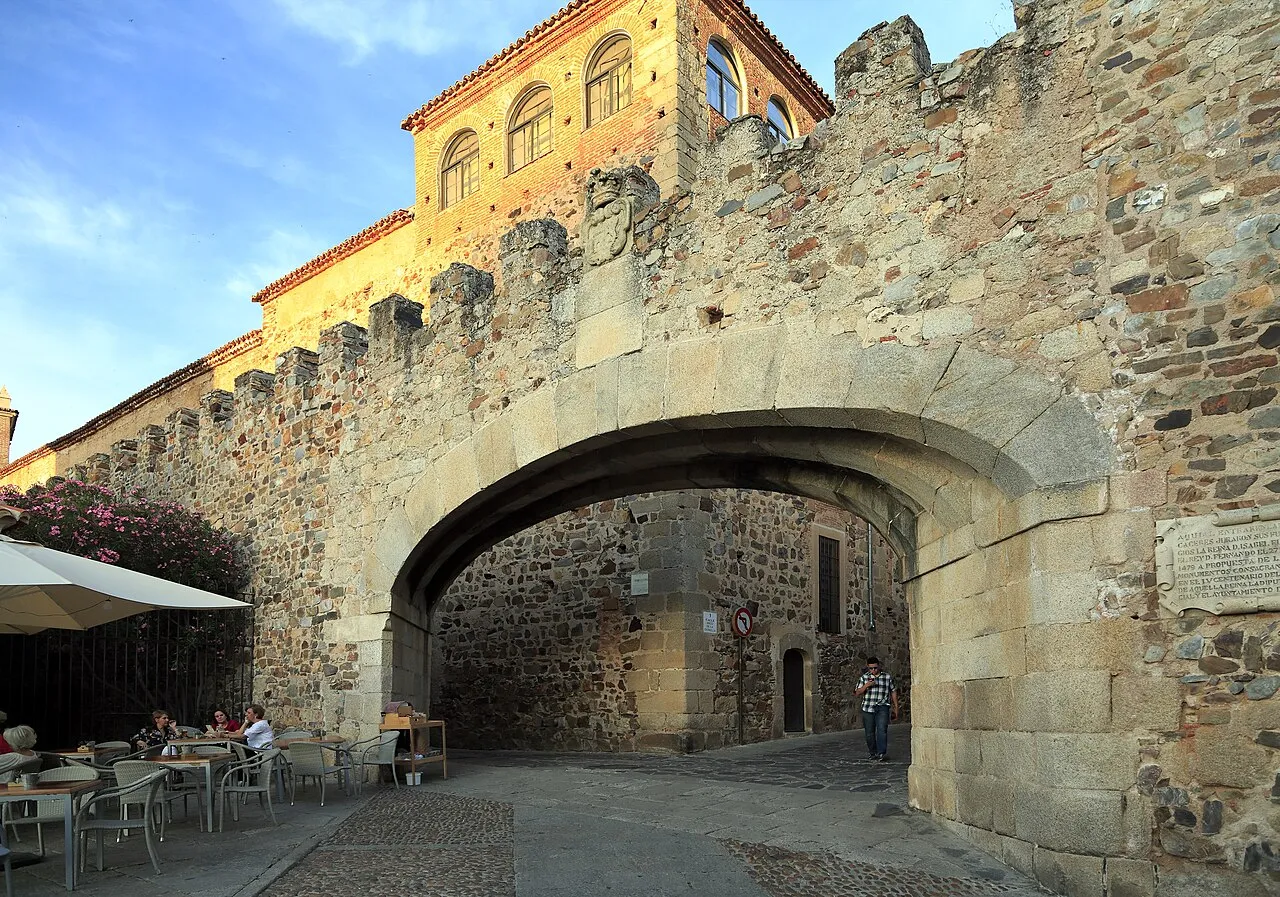
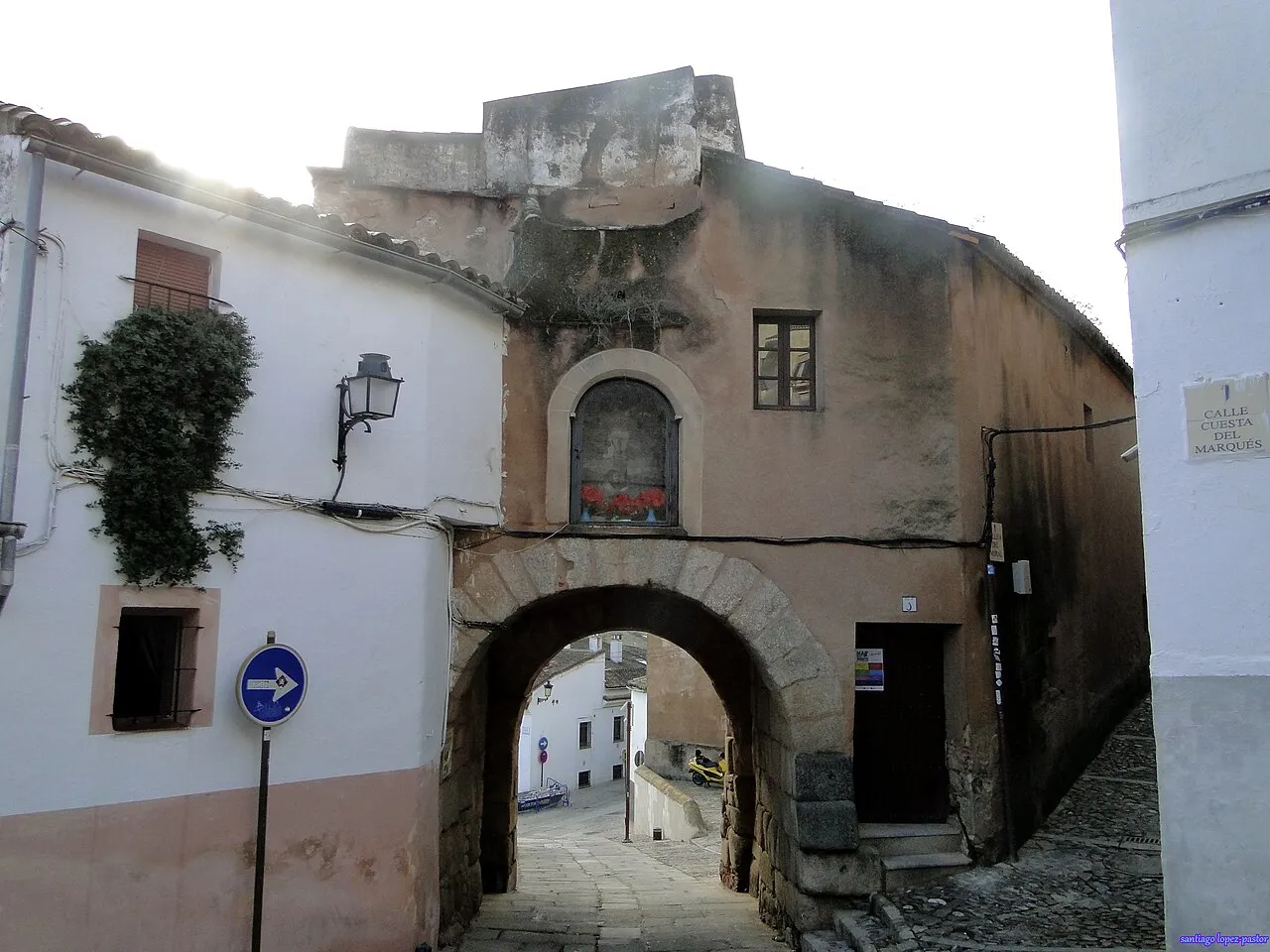
Then go in through the Arco de la Estrella, which is not an arch but a twenty-metre vaulted passage. The transition is calculated: you leave the noise and the light of the square, cross the half-dark and come out all at once into the medieval town. Cross it slowly, because it is part of the visit.
On the other side the Plaza de Santa María appears, with the co-cathedral and the Palacio de los Golfines de Abajo, the two main paid visits inside the complex. If you only go into one, make it the palace: it is the best interior open to visitors in Cáceres.
Twelfth-century Almohad rammed earth: compacted soil inside formwork, not stone, and it has been standing for eight hundred years. The horizontal bands are the seams between one lift and the next. The base is reused Roman ashlar. You can climb it, and the terrace is what orders your day.
It was widened in 1726 because the nobility's horse-drawn carriages would not fit through the earlier gate. Manuel de Lara Churriguera gave it an inner curve calculated so that a carriage could turn. Today it is the best way into the complex, and the most theatrical.
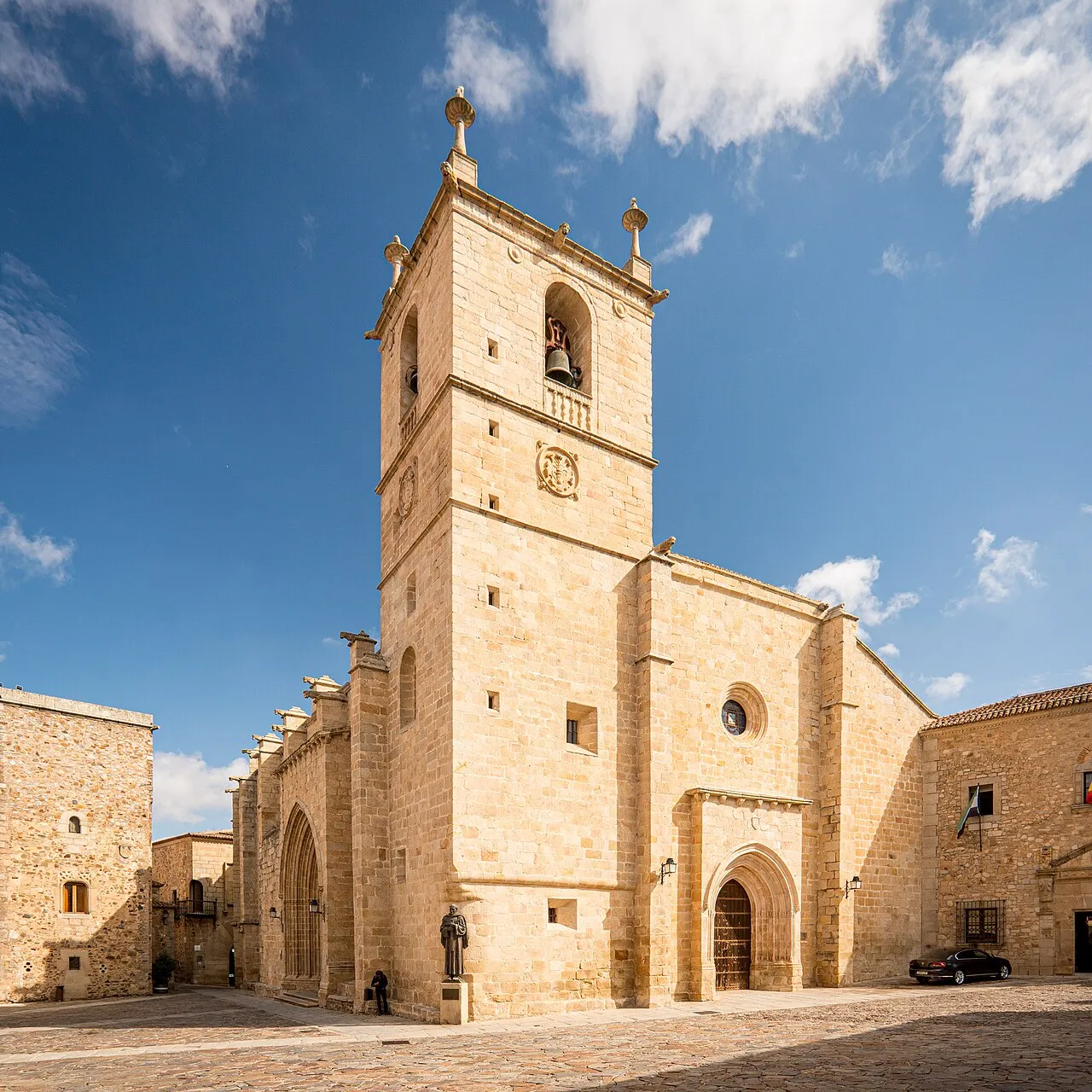
The co-cathedral of Santa María is late Gothic with the look of a fortress, and it holds two pieces that resemble nothing else: a Plateresque altarpiece carved in bare wood, neither gilded nor painted, and the fourteenth-century Cristo Negro, a crucifix in darkened wood before which the city has prayed in its worst moments.
The ticket includes the climb up the tower, and that climb is one to make: together with Bujaco these are the two high points from which you can read the complex. Before you go in, touch the feet of the statue of San Pedro de Alcántara beside the door, worn smooth and shiny by centuries of hands.
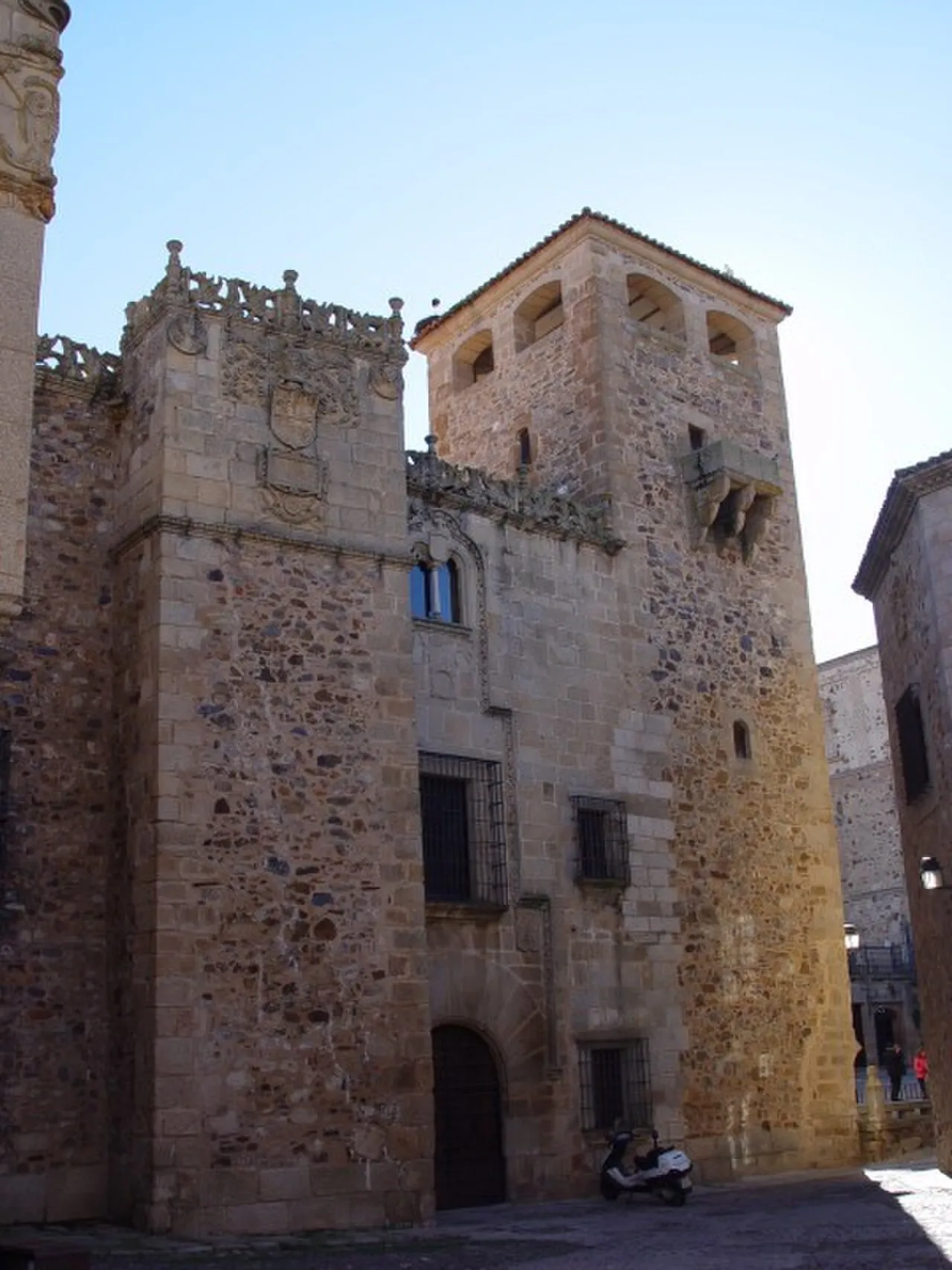
The Palacio de los Golfines de Abajo is the other visit. Its façade mixes the fifteenth-century fortified house, with its tower and machicolations, and an openwork Plateresque cresting full of fantastical animals: in fifty years the city went from building to defend itself to building to dazzle.
And it has a detail that sums up the city's history: it is the only building in the complex allowed to display its coat of arms on the façade. The Catholic Monarchs granted the Golfín family that privilege while ordering the towers of every other lineage to be lopped, after centuries of them feuding with one another.
Sturdy late Gothic, with a climbable tower that gives the best viewpoint in the city. Inside, the ungilded altarpiece and the Cristo Negro, which goes out in the small hours of Good Friday in a Via Crucis without music, with nothing but the sound of footsteps on stone.
The palace with the most cachet in the complex, and the only one allowed a coat of arms on its façade. Inside: courtyard, noble staircase, the Salón de los Linajes and a tower with views over the rooftops. The Catholic Monarchs stayed here when they visited the city.
Afternoon: out to the Roman end, and back again at night
Two hours and the night.
Cross the complex to the far end. On the way you pass the Plaza de San Jorge, the Casa del Sol, the Torre de Sande and the Casa de las Veletas, which houses the Museo de Cáceres and preserves an Almohad cistern with five aisles and horseshoe arches, one of the finest in Spain and a highly recommended visit if you have time to spare.
The end of the walk is the Arco del Cristo, the first-century Roman gate, the oldest thing still standing. You recognise it by the size of the granite ashlars, fitted almost without mortar, next to the small medieval stonework of the rest of the wall: it is the best archaeology lesson in the city and you need no guide to see it.
Beside the arch begins the barrio de San Antonio, the old Jewish quarter: narrow streets and whitewashed houses without a single palace, the exact reverse of the noble quarter. It is worth going down and walking round it before climbing back up.
And save the night. From dusk the complex is floodlit and left practically empty, because hardly anyone lives inside, while the Plaza Mayor is packed with people. Repeating the morning's route after dark is the best decision you can make in Cáceres.
First-century Roman gate, the only survivor of Norba Caesarina. This is where the branch road linking up with the Vía de la Plata left the town. It has had three names according to its use: Puerta del Río, Puerta del Concejo and the current one, after an image of Christ.
Come back here at the end. This is where you eat, have a drink and see, at the far end, the floodlit line of towers. The city inside dark and empty and the one outside full and noisy, twenty metres from each other: that is Cáceres.
Yes. The monumental complex covers about ten hectares and you can walk it end to end in a couple of hours, so a day allows the full walk, two interiors and the night-time return. A second day would fit in the Museo de Cáceres in the Casa de las Veletas, the barrio de San Antonio at a slower pace and an excursion to Trujillo or Mérida.
Where do you enter the monumental city?
There are several entrances, but the one to use is the Arco de la Estrella, from the Plaza Mayor. It is not an arch but a twenty-metre vaulted passage, and the transition is calculated: you go from the noise and the light of the square into the half-dark and from there, all at once, into the medieval town.
Which interiors are worth visiting?
Two: the Palacio de los Golfines de Abajo, with its courtyard, the noble staircase, the Salón de los Linajes and the tower; and the co-cathedral of Santa María, whose ticket includes the climb up the tower. If you are only going to go into one place, make it the palace. Most of the other palaces in the complex cannot be visited because they are still private homes or headquarters.
Can you walk along the top of the walls?
Not as a continuous walk: the wall-walk is not open, unlike Ávila. What you can climb are the towers. The Torre de Bujaco, on the Plaza Mayor, and the co-cathedral tower are the two viewpoints over the complex, and with those two you have the overall view.
What is the best time of day?
Night, without a shadow of a doubt. The complex is floodlit and left almost empty because hardly anyone lives inside, while the Plaza Mayor stays full. Repeating the morning's route after dark changes the experience completely and costs nothing.
When is the best time to visit Cáceres?
Spring and autumn. Summer in Extremadura comfortably passes forty degrees and the complex is stone, sloping and without shade, so midday is brutal. If you go in July or August, organise the day for first thing in the morning and for the night, and keep midday for interiors or a siesta.
Practical information
DurationA full day, with the night-time return included.
Start withThe Torre de Bujaco, to place the complex from above before walking it.
TicketsA municipal monuments pass if you visit three or more. The Golfines palace and the co-cathedral are charged separately.
FootwearAll pedestrian, on slopes and cobbles. Nothing with a smooth sole.
SummerExtremadura goes past 40°. In July and August, walk first thing or at night.
EatingIn and around the Plaza Mayor. Inside the complex the choice is far more limited.
On the map
🎧 With Viavoy
Walk Caceres and listen at your own pace
Download Viavoy and walk Caceres offline, whenever you like.
from 3,99 €· one-off payment
City Pass · 9,99 €3 days, all the tours in Caceres