Emerita Augusta: why Mérida has so much Roman in it
A city founded from scratch to retire legionaries that ended up as a provincial capital. What that means in stone, and why it survived when other Roman capitals disappeared.
There are Roman cities that grew on top of earlier settlements and Roman cities that were drawn on paper. Mérida is one of the second kind: it was founded in 25 BC from scratch, with a plan, a budget and a specific function. Understanding that function explains why it has a theatre, an amphitheatre, a circus, a forum, temples, an eight-hundred-metre bridge and a water system with reservoirs of its own.
The name says it all: emeritus means “honourably discharged”. Mérida was founded to retire soldiers, and its present place name is a corruption of that word.
A city to retire legionaries
Augustus had just brought the Cantabrian Wars to a close, the last campaign of conquest in Hispania, and he had a classic problem for the end of any war: what to do with the veterans. Discharging whole legions without giving them somewhere to go was a sure way of creating instability.
The Roman solution was to found colonies. A strategic site was chosen, plots of land were shared out among the emeriti and they were given a city with full legal status. In 25 BC it was the turn of this ford on the Guadiana, and so Colonia Iulia Augusta Emerita was born.
The veterans came from the V Alaudae and X Gemina legions. They were not just any settlers: they were Roman citizens with twenty years of service, military discipline and a direct interest in making the new city work. Rome was not giving away land, it was planting a loyal community in newly subdued territory.
And it soon rose in rank: Emerita became the capital of the province of Lusitania, one of the three into which Hispania was divided. That status as a capital is what brought the public money, and the public money is what you can visit today.
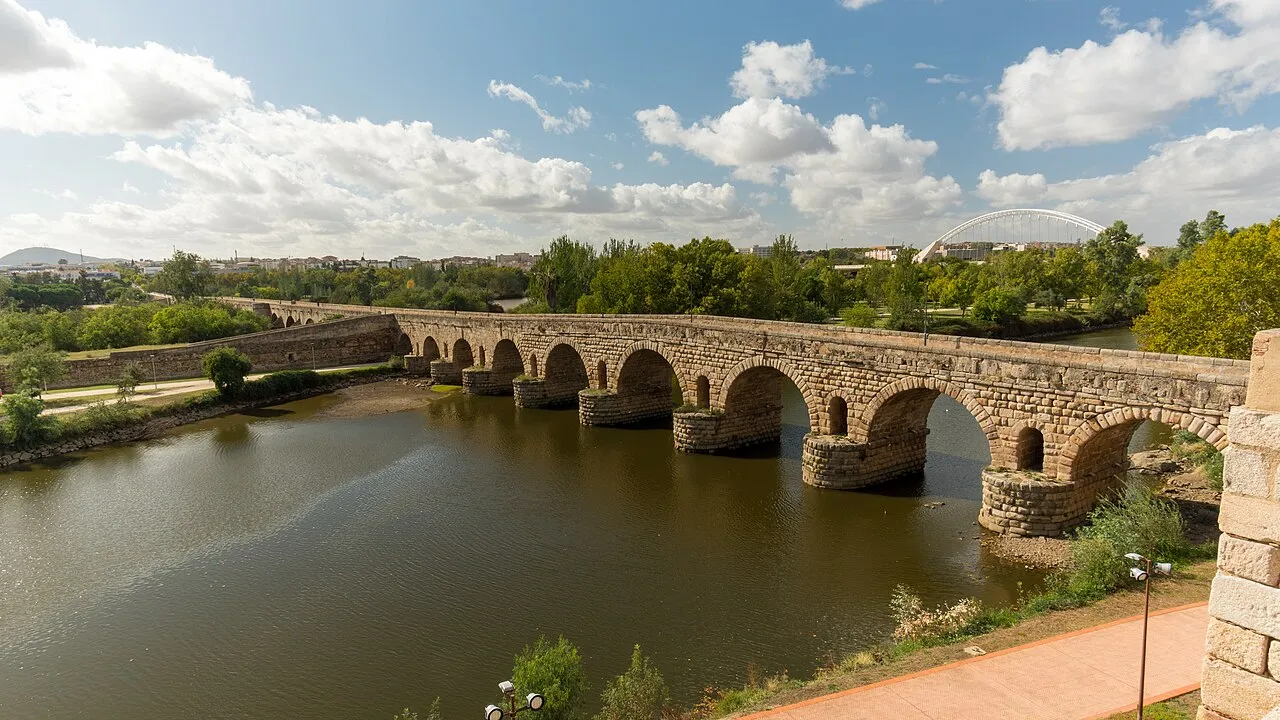
The reason the city is here and not two hundred metres further along. Almost eight hundred metres and sixty arches over a ford in the river, where the Vía de la Plata crossed. A provincial capital needed a monumental entrance, and this was one for twenty centuries.
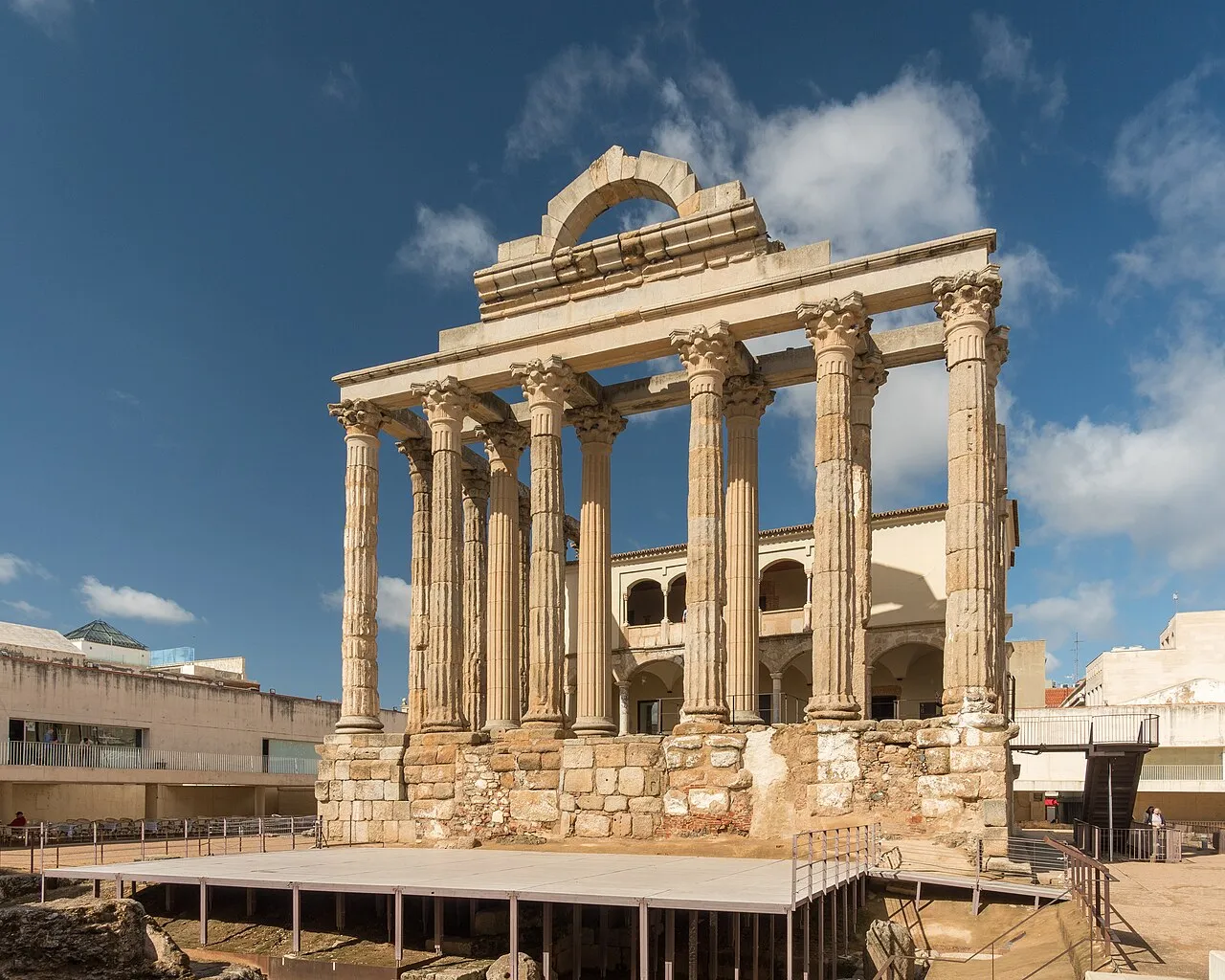
The building of the imperial cult, dedicated to Rome and the deified emperor, which presided over the municipal forum. It is not devotion: it is the building that reminds you daily who is in charge. It is the only Roman temple still standing in the city.
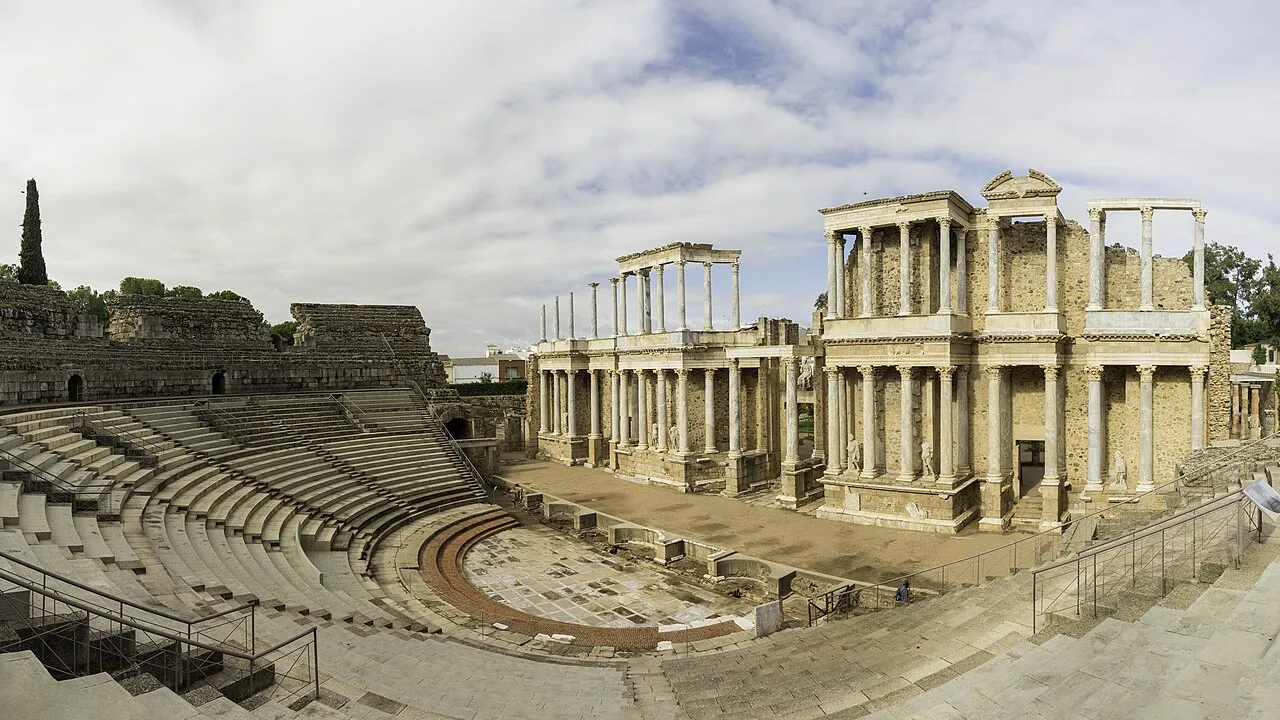
The theatre arrived around 16 or 15 BC, barely a decade after the foundation, and the amphitheatre in 8 BC. That speed is no accident: public buildings were the instrument with which Rome taught people to live in the Roman way. A colony without a theatre was not a complete Roman city.
To that was added the circus, for chariot races, with room for some thirty thousand people: more than the theatre and the amphitheatre together, and one of the best preserved examples of this kind of building in the Empire. It lies somewhat away from the centre and that is why it is visited far less than it deserves.
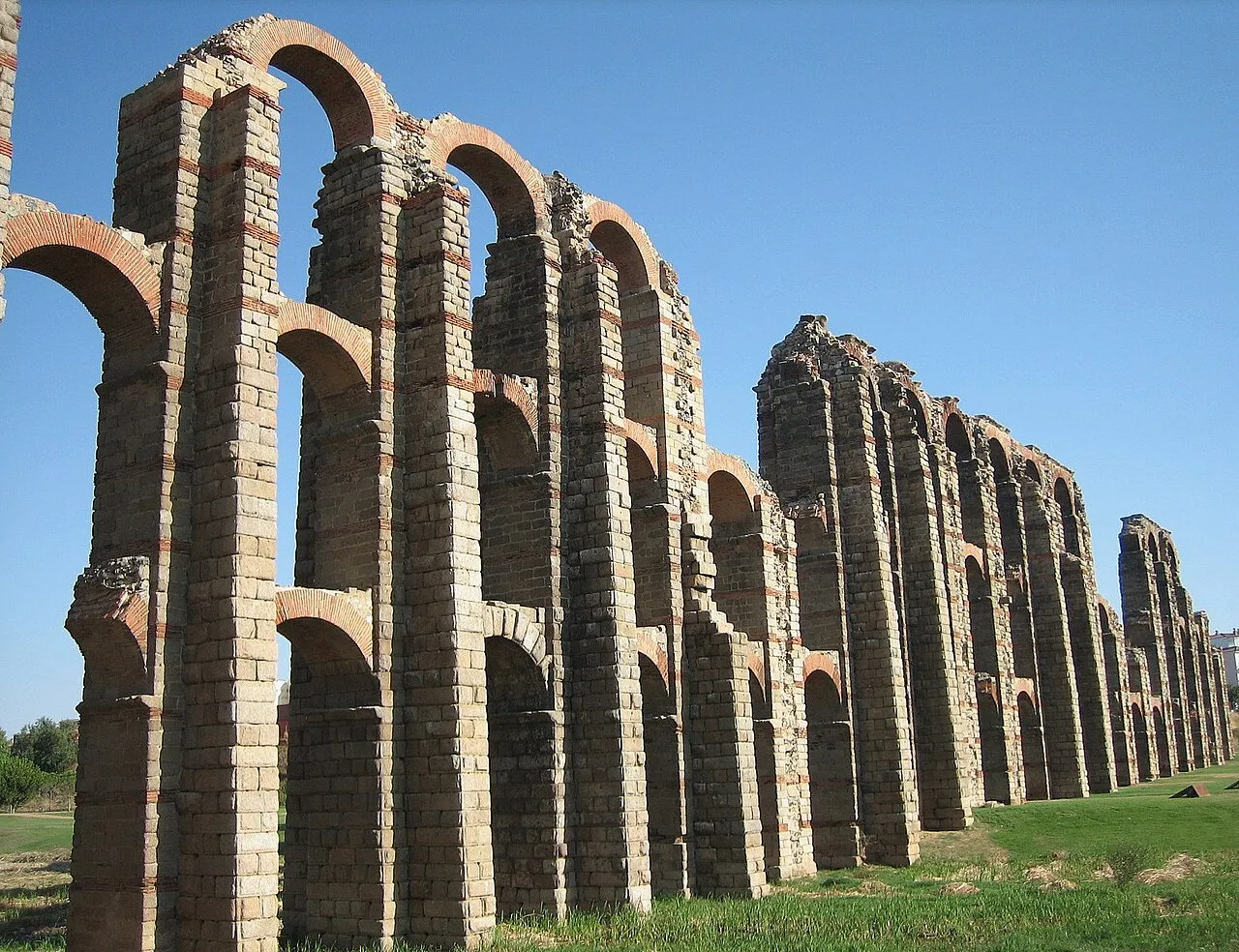
The water system is what most impresses an engineer. They did not simply tap a spring: they built reservoirs — the one at Proserpina still exists — channels running for kilometres and monumental arcades to keep the gradient where the ground dropped away. The Aqueduct of Los Milagros is only the visible part of that network.
And there were the provincial forum, distinct from the municipal one, the temples, the baths, the road network and the suburban villas with mosaics, such as the Casa del Mitreo. All of it in a city that at its peak can hardly have gone beyond twenty or thirty thousand inhabitants.
The visible part of a complete water network that brought water from the Roman reservoir of Proserpina. Up to twenty-five metres high, all by gravity, with a minimal and constant gradient. Where the ground dropped, the arcade rose to compensate.
Emerita went on being important long after Rome. It was the Visigothic capital of Lusitania, a weighty episcopal see and, after the Muslim conquest, a significant city until it rebelled against the emirate and was punished with the building of the alcazaba, in 835, to control it from within.
From then on, decline. The city shrank a great deal in size and for centuries occupied only part of the Roman perimeter, leaving the rest turned into fields or half-buried ruins. That, which was a misfortune for its inhabitants, turned out to be the best possible preservation.
The great buildings were used as a quarry — hence the missing marbles and ashlars everywhere — but nothing was built on top of them. The theatre lay buried almost to the top of the seating tiers and nobody suspected what was underneath until excavation began in 1910.
Since then, more than a century of continuous urban archaeology has been bringing to light the complex you visit today, declared a World Heritage Site in 1993. And things keep turning up: in Mérida, digging the foundations of a new building usually means calling the archaeologists.
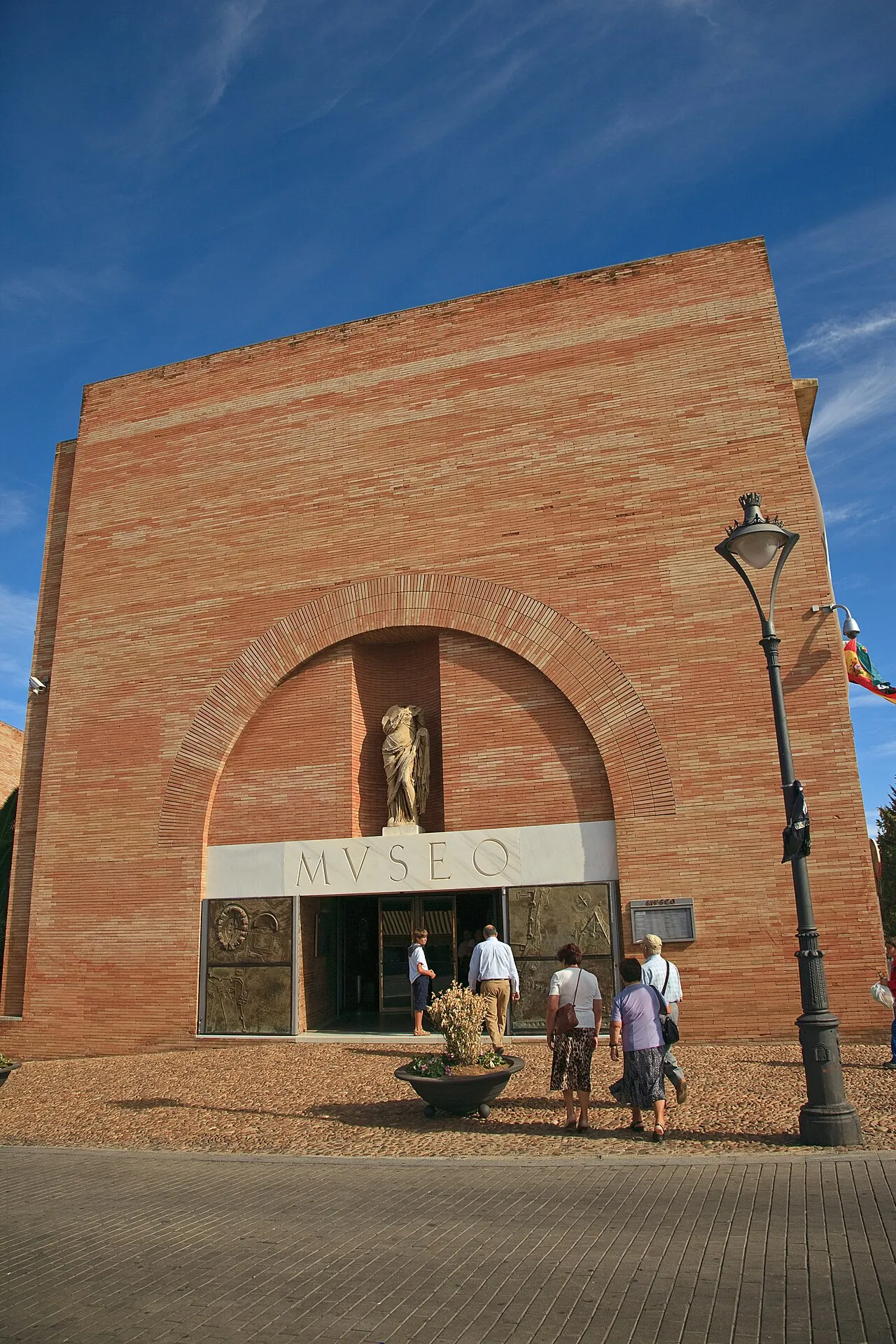
Here is what came out of all that: imperial portraits, mosaics hung like paintings, coins, glass and household objects. The collection comes almost entirely from excavations in the city itself, so it is not an accumulation of pieces, it is the contents of a site.
City of the emeriti of Augustus. Emeritus was the soldier honourably discharged after completing his service, and the colony was founded in 25 BC precisely to settle the veterans of the V Alaudae and X Gemina legions after the Cantabrian Wars. The present place name, Mérida, is the corruption of that word.
Why does Mérida have so many Roman monuments?
Because it was the capital of the province of Lusitania, one of the three into which Hispania was divided. A provincial capital received systematic public investment: theatre, amphitheatre, circus, forum, temples, baths, a monumental bridge and a water network with reservoirs of its own. All of that is what you visit today.
How many people lived in Emerita Augusta?
The most usual estimates speak of between twenty and thirty thousand inhabitants at its peak, which makes the size of its public buildings even more striking: the circus alone had room for some thirty thousand people, more than the entire population of the city. The great spectacles drew people from across the province.
Why did the complex survive so well?
Because after the Middle Ages the city shrank a great deal and occupied only part of the Roman perimeter, leaving the rest as fields or half-buried ruins. The buildings were used as a quarry, but nothing was built on top of them. The theatre was buried almost to the top of the seating tiers until it was excavated from 1910 onwards.
What happened to Mérida after Rome?
It went on being important: Visigothic capital of Lusitania and a weighty episcopal see. After the Muslim conquest it kept its significance until it rebelled against the Emirate of Córdoba and was punished with the building of the alcazaba, in the year 835, raised precisely to control the city from within.
Do remains still turn up?
Constantly. Mérida has had more than a century of continuous urban archaeology and digging the foundations of a new building usually means calling the archaeologists. A good part of the complex you can visit today — the circus, the Casa del Mitreo, the Morería area — came to light in excavations much later than those of the theatre.
Practical information
Foundation25 BC, by order of Augustus, to settle veterans of the V Alaudae and X Gemina legions.
What the name meansEmeritus: honourably discharged. Mérida is the corruption of that word.
StatusCapital of the Roman province of Lusitania, one of the three in Hispania.
FacilitiesTheatre, amphitheatre, circus, forum, temples, baths, a monumental bridge and a water network with reservoirs.
Why it survivedThe city shrank after the Middle Ages and nothing was built on top. It served as a quarry, not as a building plot.
HeritageDeclared a World Heritage Site in 1993. The excavations are still active.
On the map
🎧 With Viavoy
Walk Merida and listen at your own pace
Download Viavoy and walk Merida offline, whenever you like.